Discover how social listening in 2026 helps you catch trend signals early, before they hit viral, using search, comment insights, and a weekly routine that drives conversions.

Read Time
8 min

Introduction
By the time a trend hits your feed, it is usually already on its second life. And you are just standing there like: “Wait, are we still doing that?”
That is exactly why social listening matters in 2026. Not as a nice to have, but as your brand’s early warning system.
Because trends do not arrive neatly packaged. They leak through comment sections, niche communities, search bars, and tiny shifts in the way people talk about what they want. By the time something is everywhere, it has already been copied, formatted, and exhausted.
The goal is not to chase every shiny hashtag. The goal is to spot the right signals early, frame them with intention, and turn them into content people actually want to save, share, and buy from. In 2026, social is not just a feed. It is where discovery happens, where trust starts forming, and where customers quietly tell you what they need next.
1. Why “viral” is already too late in 2026
Virality sounds like the goal, but in 2026 it is often the end of the cycle, not the beginning. By the time something is everywhere, it has already been repeated, remixed, and diluted. The real advantage is not chasing what is peaking, but listening for what is building quietly underneath.
1.1 Social is the new search engine
Social media is no longer just where people scroll. It is where they research, compare, and decide.
Sprout Social’s 2025 research found that 41% of Gen Z turns to social first when looking for information, and 76% of consumers say social content influenced a purchase in the last six months. That means trends are not just entertainment, they are signals of intent.
1.2 Discovery is driven by relevance, not followers
In 2026, reach is less about who follows you and more about what the algorithm believes is valuable in the moment. Platforms push content based on saves, shares, watch time, and repeated interest patterns, not just audience size.
Hootsuite highlights that discovery now depends on understanding micro behaviors and emerging conversations early, not simply posting more.
Source: Hootsuite Social Trends Report (2026)
1.3 People are curating their feeds more than ever
Users are not passive anymore. They actively shape what they see.
Meta has introduced tools like the ability to reset Instagram recommendations and refine suggested content. TikTok has expanded topic controls and keyword filtering. This means your content must earn relevance, because audiences are literally training their feeds to show less noise.
1.4 Viral is the echo, signals are the source
The biggest shift in 2026 is simple: brands that win are not the ones that react fastest, but the ones that listen earliest.
Trends do not start when they go viral. They start when people begin repeating the same questions, emotions, and behaviors in small corners of the internet. Social listening helps you catch those moments before they become mainstream, so you can create content that feels timely, not tired.
2. What a real trend signal looks like (vs. noise)
A trend is not just a sound that everyone uses for 36 hours.
A real trend is a repeatable pattern in language, emotion, behavior, or format that starts showing up in multiple places at once. It is not random. It is culture moving in small steps before it becomes obvious.
TikTok’s 2026 forecast leans into this idea directly. Their concept of “Trend Signals” is designed to reflect how communities evolve in real time, powered by AI but grounded in human instinct.
So what do you actually listen for?
2.1 Language shifts: the words people suddenly keep repeating
This is where social listening becomes incredibly powerful. It gives you the exact phrasing your audience is already using before it ever reaches brand messaging.
A trend signal can be as simple as a new way people describe the same old problem.
“I’m burnt out” becomes “I’m overstimulated.”
“I need motivation” becomes “I need accountability.”
“This is expensive” becomes “this feels like a scam.”
These micro shifts matter because they become your hooks, your headlines, your landing page language, and your ad angles.
And if you have already explored how tone drives connection in our Why Social Media Needs Humor (And How to Frame It) article, this is the serious cousin of that. Humor works because it mirrors culture, but listening is how you know what culture actually sounds like this week.
2.2 Behavior shifts: saves, shares, and high intent comments
Engagement is not just applause anymore. In 2026, engagement is often intent.
Sprout Social found that 76% of consumers say social content influenced a purchase in the last six months. That means a lot of trend behavior is actually shopping and research behavior disguised as scrolling.
So when you start seeing comment patterns like:
“Where did you get this?”
“Can you drop the link?”
“Does this work for me?”
“What would you do if you started today?”
You are not just seeing interaction. You are seeing demand forming in real time.
2.3 Community shifts: niche groups become mainstream pipelines
Trends rarely start on the main stage. They start in smaller corners of the internet. Sprout also reports that 51% of global users plan to spend more time on community based platforms like Reddit, especially Gen Z and Millennials.
That matters because communities are where people ask unfiltered questions, share screenshots of tools and products, argue about what is overrated, and admit what they are confused about.
That is not noise. That is insight. And if you listen closely, it is basically free positioning research.
3. The FRAEM Trend Radar: Signal → Pattern → Proof → Play
At FRAEM, the goal is not to collect trends like Pokémon.
The goal is to turn listening into a repeatable system, so you can catch signals early without losing your sanity or your brand voice. Because trends are not strategy. The strategy is knowing what matters, why it matters, and how to respond with intention.
Here is the framework we come back to every time.
3.1 Signal: catch the spark
A signal is a small early indicator that something is shifting.
Signals usually show up in the same three places first:
Comment sections, where people ask real questions and share real objections
Search bars, where people reveal what they are actively trying to solve
Niche creators, where formats and language appear before they go mainstream
The trick is simple. You are not hunting for viral content. You are collecting recurring friction and recurring desire.
FRAEM pro tip: screenshot the comments, not just the posts. Posts show performance. Comments show psychology.
3.2 Pattern: cluster what you are seeing
One post is content. Ten posts might be coincidence. But repeated themes across different accounts is a pattern.
When you cluster signals, you are usually clustering into human needs. Things like:
A new desire, like wanting life to feel calmer, faster, or more confident
A new fear, like not trusting a product or feeling overwhelmed by scams
A new standard, like expecting everything to be instant, personal, and simple
Notice how none of this depends on a trending audio. Trends are rarely about the format first. They are about the feeling underneath.
3.3 Proof: confirm it before you bet your calendar on it
This is the step most brands skip, and then wonder why their trend content falls flat.
Proof means validating a pattern before you commit to it. You check if it shows up across multiple creators and communities, if people are searching for it, and if it survives outside one niche bubble.
3.4 Play: turn it into something worth saving
This is where FRAEM tone matters. We do not repost. We frame.
TikTok’s 2026 guidance emphasizes staying flexible, checking in on real conversations, and leaving room for humanity, humor, and imperfection instead of locking content too far in advance.
So your play should create value, not noise. That usually looks like:
A point of view that makes people feel seen
A practical explainer that reduces confusion
A myth bust that clears the wrong narrative
A repeatable format series that you can scale without losing quality
That is the difference between trend chasing and trend framing.
4. The 30 minute listening routine (that does not destroy your soul)
You do not need to spend six hours a day scrolling to stay relevant. Social listening works best when it is light, consistent, and repeatable. In 2026, the brands that spot trends early are not the ones consuming the most content. They are the ones checking in regularly, collecting signals, and turning them into action before they peak.
Think of it like radar. You are not living inside the storm. You are simply watching the pressure change.
4.1 The 10 10 10 scan
Twice a week, block 30 minutes. That is enough to stay ahead.
Spend the first 10 minutes in platform search. Use the way people actually type:
“how do I…”
“best way to…”
“is this worth it…”
“alternatives to…”
Search is where intent lives. It tells you what people want before they ever say it out loud.
Next, spend 10 minutes in comment sections. This is where the most honest information shows up. Posts tell you what performed. Comments tell you what people are confused about, what they want, and what they are ready to buy.
Then spend the last 10 minutes inside one community space. Reddit, niche creator circles, industry threads, anywhere people speak without brand polish. Communities are often where trends form before they ever reach the main feed.
4.2 Score it before you ship it
Not every signal deserves a full content sprint. Some are noise. Some are gold. The point of scoring is to slow down just enough to make a smart decision.
This is where your Trend Confidence Score comes in
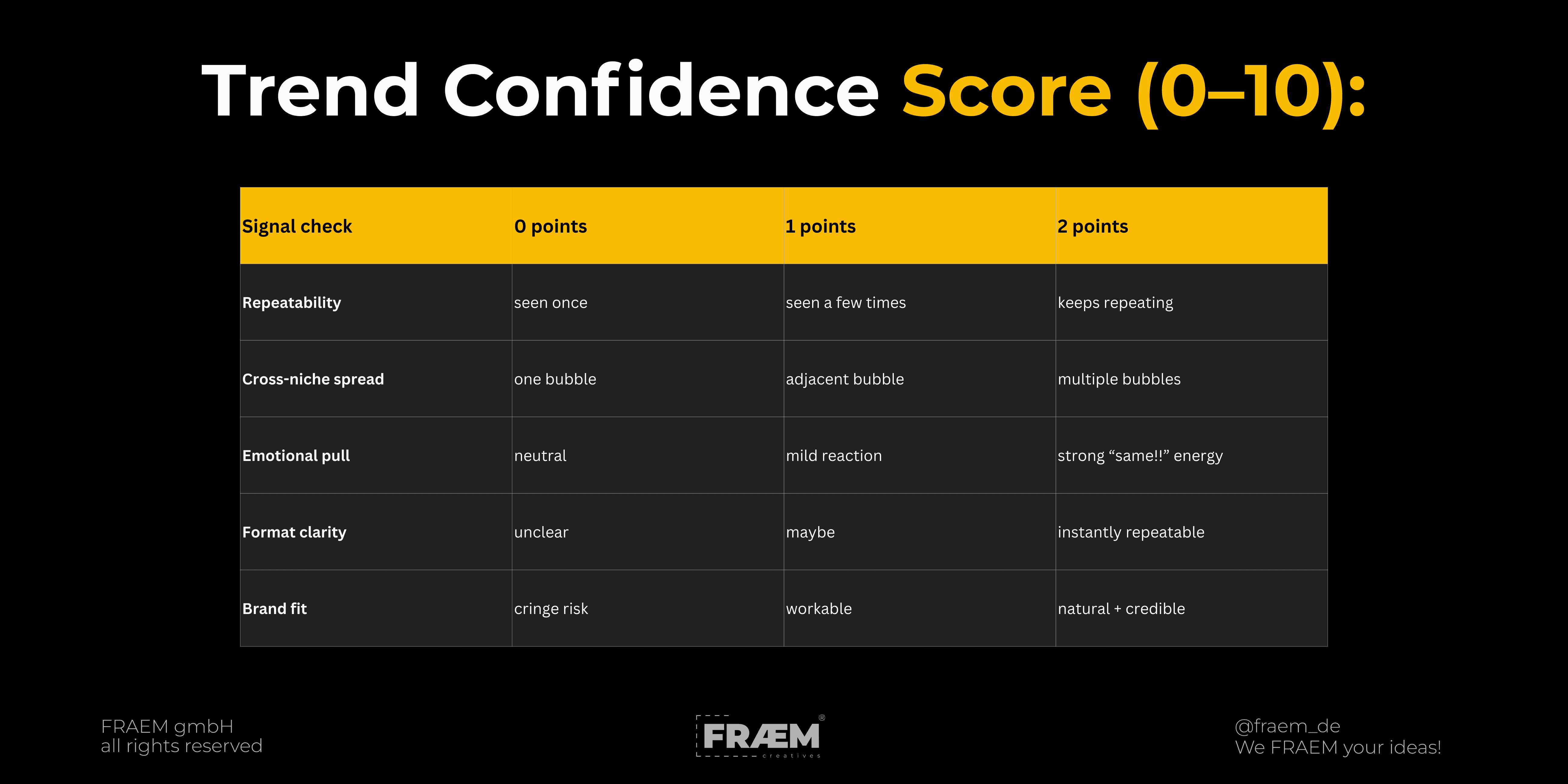
A simple rule works:
0 to 4 means watch it
5 to 7 means test it
8 to 10 means build around it
This keeps you from jumping on everything, and it keeps your content strategy intentional instead of reactive.
4.3 The test post rule
Before you turn a trend into a campaign, ship one small test. One post. One hook. One format. One clear takeaway.
Then look for real signals, not vanity metrics. Saves, thoughtful comments, DMs, clicks, questions. If people respond with curiosity, you scale it. If it dies quietly, you move on. Social listening is not about doing more. It is about doing the right thing at the right moment, with just enough structure to stay ahead without burning out.
5. Turning trends into content that converts
Here is the part most brands miss: a trend is not a strategy. A trend is a doorway.
Social listening only becomes valuable when you translate what you hear into something people can actually act on. Otherwise, you are just collecting interesting internet moments with nowhere to put them.
The real goal is to take a signal and turn it into content that builds trust, reduces friction, and moves someone one step closer to choosing you.
5.1 Make trend content useful, not just timely
A trend only works if you add something to it.
The internet does not need another repost of the same format. What people save and share is the version that teaches them something, frames the topic clearly, or makes them feel understood.
That is the difference between copying a trend and owning it.
5.2 Connect the signal to a clear next step
If your content sparks interest but the next step is unclear, the moment dies.
When someone resonates with a post, they are already halfway in. Your job is to guide them somewhere simple:
a landing page that answers the obvious question
a service that solves the pain behind the trend
a call to action that feels natural, not forced
Trends create attention. Clarity turns attention into movement.
5.3 Build a loop, not a one off post
The smartest use of social listening is not a single viral hit. It is a repeatable cycle.
A signal becomes a test post.
A test post becomes a format series.
A series becomes a message your audience starts associating with you.
That is how you stay relevant without constantly reinventing yourself. Because in the end, the goal is not to ride trends.
The goal is to build trust fast enough that when people are ready, your brand is already the obvious choice.
6. Final Thought: Don’t chase virality. Build radar.
Social listening is not about being first.
It is about being early enough to understand what people actually want, before the internet turns it into a template. Early enough to hear the language your audience is using, before it becomes overused and cringe. Early enough to create something genuinely useful, before the feed is flooded with copies that all look the same.
Because trends are not the goal. Trends are signals. They are the surface evidence of deeper shifts in desire, frustration, taste, and attention.
The brands that win in 2026 will not be the loudest or the fastest. They will be the ones that listen closely, respond with clarity, and show up with content that feels intentional instead of reactive.
At FRAEM®, we do not chase trends for the sake of it. We build radar. We turn audience intelligence into creative framing, and creative framing into content that converts, and does not suck.
Frequently Asked Questions!
What is social listening, really?
Social listening is the practice of tracking and analyzing conversations, questions, and behaviors across social platforms to uncover insights about your audience, competitors, and culture before those insights become obvious.
AI Search Is Here. SEO Isn't Dead. Here's What Matters.
43% of Germans use ChatGPT. Search is quietly changing under everyone's feet. Here's what's real, what's hype, and what your business should actually do about it.

Why Your Handwerk Website Isn't Doing Its Job
94% of German Handwerk businesses have a website. Only 3 of 500 audited sites came close to actually doing their job. Here's what "it works for us" is really costing you.

Framer vs. WordPress vs. TYPO3
Framer or WordPress for your Handwerk business? An honest comparison on cost, maintenance, and SEO. Plus when Webflow or TYPO3 actually makes sense.