Phase 03 – Kreieren
Phase 03 – Kreieren
Content Production:
Content Production:
Einmal drehen, monatelang posten.
Einmal drehen, monatelang posten.
Wir produzieren über die volle Bandbreite: Foto, Video, Motion, Text. Jedes Stück entsteht für die Plattform und die Zielgruppe, für die es gedacht ist, nicht als Zweitverwertung von woanders. Ein Briefing, ein Qualitätsanspruch, alle Formate.
Wir produzieren über die volle Bandbreite: Foto, Video, Motion, Text. Jedes Stück entsteht für die Plattform und die Zielgruppe, für die es gedacht ist, nicht als Zweitverwertung von woanders. Ein Briefing, ein Qualitätsanspruch, alle Formate.
Die Definitionszeile
Content-Produktion ist die Herstellung der Inhalte, mit denen eine Marke in ihren Kanälen auftritt: Foto, Video, Motion und Social-Formate. Sie beantwortet die Frage, was gezeigt wird, nicht die Frage, wann und wo es erscheint.
Content-Produktion ist die Herstellung der Inhalte, mit denen eine Marke in ihren Kanälen auftritt: Foto, Video, Motion und Social-Formate. Sie beantwortet die Frage, was gezeigt wird, nicht die Frage, wann und wo es erscheint.
Content-Produktion ist die Herstellung der Inhalte, mit denen eine Marke in ihren Kanälen auftritt: Foto, Video, Motion und Social-Formate. Sie beantwortet die Frage, was gezeigt wird, nicht die Frage, wann und wo es erscheint.
Scope
Was drin ist


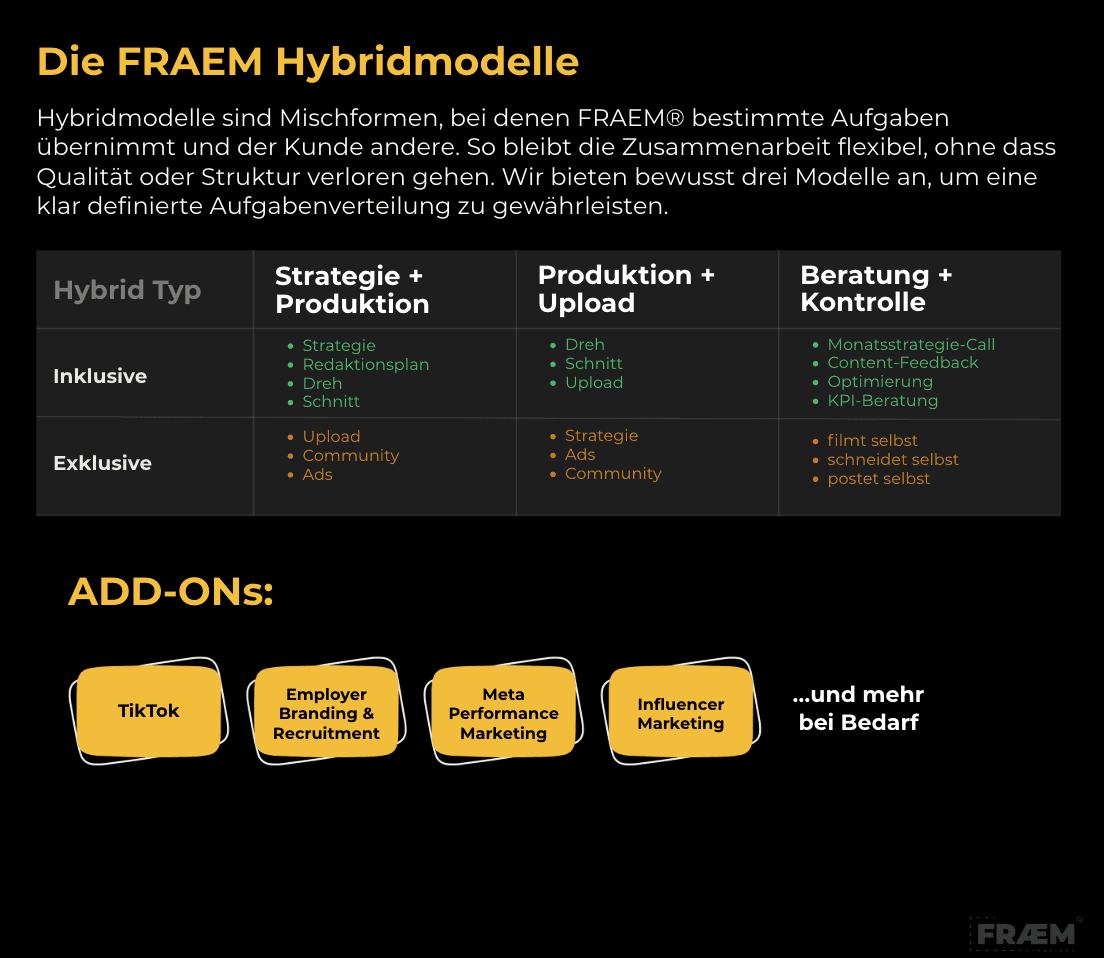
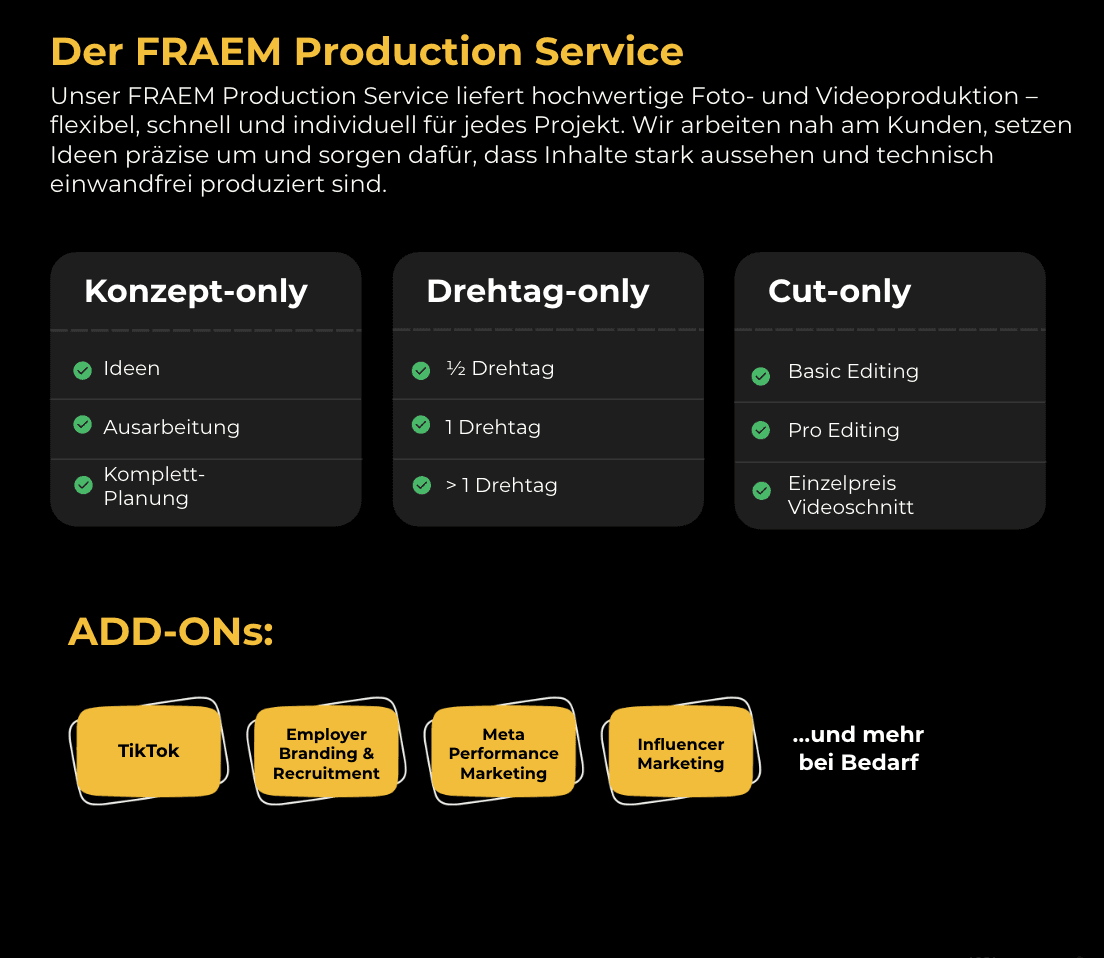
Unsere Content-Marketing-Modelle
Unsere Content-Marketing-Modelle
Klare Strukturen. Keine Ratespiele.
Erfolgreiches Content-Marketing braucht mehr als einzelne Leistungen.
Deshalb arbeitet FRAEM mit drei klaren Zusammenarbeits-Modellen – je nachdem, wie viel Verantwortung du abgeben möchtest.
Umfassendes Content-Marketing.
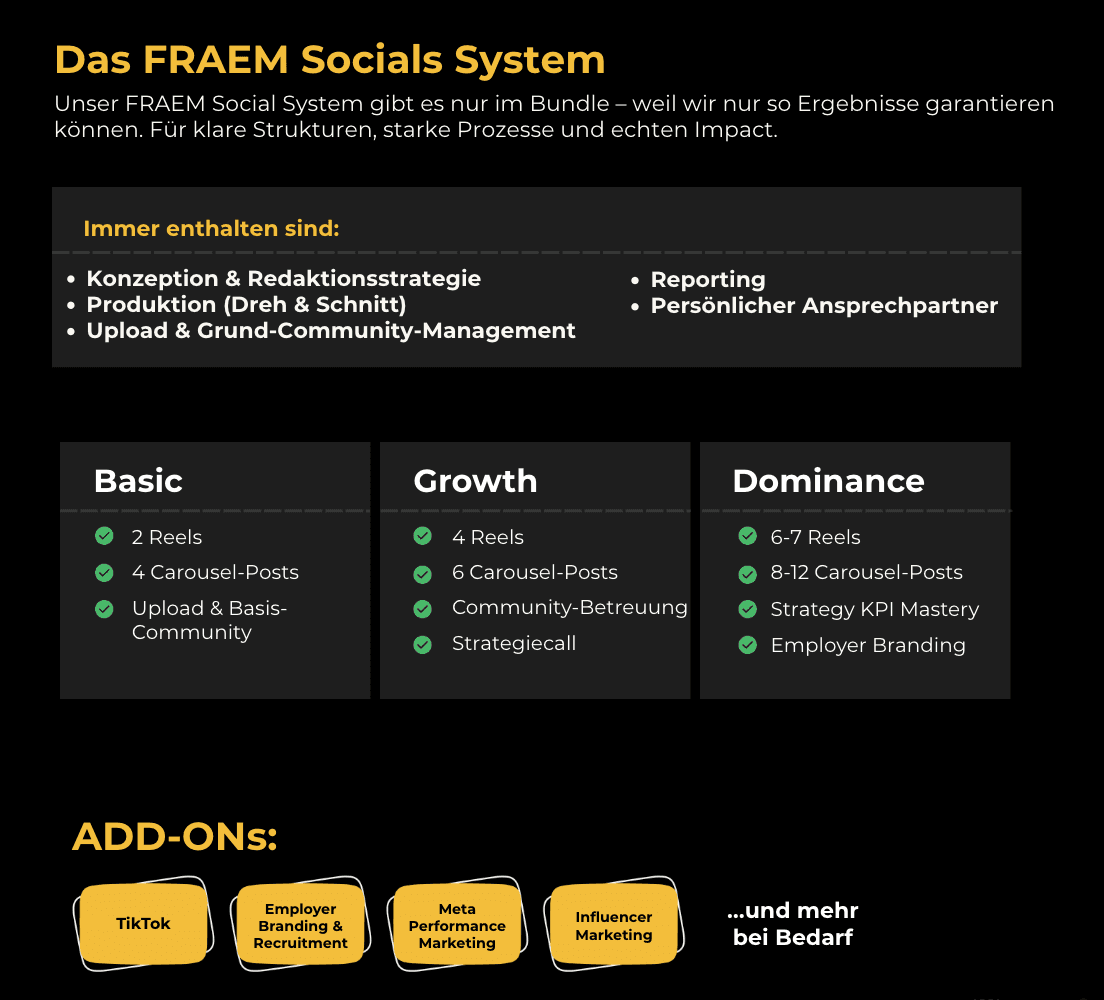
Das FRAEM Socials System
Umfassendes Content-Marketing.
Das FRAEM Socials System
Umfassendes Content-Marketing.
Das FRAEM Socials System
Nur Ausführung.
FRAEM Produktionsservice
Nur Ausführung.
FRAEM Produktionsservice
Nur Ausführung.
FRAEM Produktionsservice
Geteilte Verantwortung.
FRAEM Hybrid-Modelle
Geteilte Verantwortung.
FRAEM Hybrid-Modelle
Geteilte Verantwortung.
FRAEM Hybrid-Modelle
Problem List
Das ist für dich, wenn
Der Kanal ist da, das Material nicht.
Jede Woche dieselbe Diskussion, was man posten könnte, und am Ende geht wieder ein Stockfoto raus.
Ihr dreht einmal im Jahr, danach ist es still.
Ein großer Film, zwölf Monate Pause. Kanäle leben aber von Nachschub und nicht von einem Höhepunkt.
Die Inhalte sehen nach vier verschiedenen Firmen aus.
Jeder Dreh hatte ein anderes Team und eine andere Idee. Zusammen ergibt das keine Marke, sondern eine Sammlung.
KI liegt nahe, aber keiner weiß, was erlaubt ist.
Seit August gelten die Transparenzpflichten der KI-Verordnung, und niemand im Haus will derjenige sein, der das falsch macht.
Der Kanal ist da, das Material nicht.
Jede Woche dieselbe Diskussion, was man posten könnte, und am Ende geht wieder ein Stockfoto raus.
Ihr dreht einmal im Jahr, danach ist es still.
Ein großer Film, zwölf Monate Pause. Kanäle leben aber von Nachschub und nicht von einem Höhepunkt.
Die Inhalte sehen nach vier verschiedenen Firmen aus.
Jeder Dreh hatte ein anderes Team und eine andere Idee. Zusammen ergibt das keine Marke, sondern eine Sammlung.
KI liegt nahe, aber keiner weiß, was erlaubt ist.
Seit August gelten die Transparenzpflichten der KI-Verordnung, und niemand im Haus will derjenige sein, der das falsch macht.
Reference

So sah das bei AL-KO aus.
So sah das bei AL-KO aus.
Zwei Marken in drei Märkten sichtbar halten, ohne dass beide gleich klingen.
TikTok: Echte Einblicke hinter die Kulissen
Statt eine Kampagne zu drehen und sie zu verteilen, produzieren wir laufend: Themenplanung nach Saison, Instagram und TikTok plattformgerecht statt zugeschnitten, zwei getrennte Bildwelten für AL-KO und solo®. Die Marken zu trennen war unsere Empfehlung. Was organisch funktioniert, bekommt danach bezahlte Unterstützung.
Jede Plattform spielte eine eigene Rolle innerhalb der Kampagne. Instagram wurde für eine strukturierte und informative Erzählweise genutzt, damit potenzielle Bewerber die Arbeitsumgebung und die Ausbildungsrollen klar und professionell verstehen können. TikTok konzentrierte sich auf informellere, nachvollziehbare und 'Behind-the-Scenes'-Inhalte, die das Unternehmen für jüngere Zielgruppen näher und zugänglicher erscheinen ließen.
Social-first Content Production
Video and photo production
Motion Design & Animation



Inhaltsgestaltung in Aktion
Inhaltsgestaltung in Aktion
Inhaltsgestaltung in Aktion
Ein kleiner Einblick in die Unternehmen, die wir beim Content-Erstellen unterstützen durften.
Ein kleiner Einblick in die Unternehmen, die wir beim Content-Erstellen unterstützen durften.
Ein kleiner Einblick in die Unternehmen, die wir beim Content-Erstellen unterstützen durften.
„Die meisten Unternehmen haben kein Content-Problem, sondern ein Nachschub-Problem. Einmal im Jahr ein Film hilft elf Monate lang niemandem."
„Die meisten Unternehmen haben kein Content-Problem, sondern ein Nachschub-Problem. Einmal im Jahr ein Film hilft elf Monate lang niemandem."
„Die meisten Unternehmen haben kein Content-Problem, sondern ein Nachschub-Problem. Einmal im Jahr ein Film hilft elf Monate lang niemandem."


Wie aus einem Tag ein Vorrat wird
Unser Prozess
Warum Content nicht pro Stück gekauft wird.
Warum Content nicht pro Stück gekauft wird.
Ein einzelner Beitrag kostet fast so viel wie zehn, weil der Aufwand im Hinkommen, Aufbauen und Entscheiden steckt und nicht im Auslösen. Deshalb planen wir in Drehtagen und nicht in Beiträgen.
Ein einzelner Beitrag kostet fast so viel wie zehn, weil der Aufwand im Hinkommen, Aufbauen und Entscheiden steckt und nicht im Auslösen. Deshalb planen wir in Drehtagen und nicht in Beiträgen.
1
Planung
Aus einer Liste wird der Umfang.
Vor dem Dreh steht fest, welche Formate gebraucht werden und wofür. Diese Liste entscheidet, ob abends Material da ist oder nur schöne Aufnahmen. Sie ist der Teil, der nichts kostet und alles bestimmt.
1
Planung
Aus einer Liste wird der Umfang.
Vor dem Dreh steht fest, welche Formate gebraucht werden und wofür. Diese Liste entscheidet, ob abends Material da ist oder nur schöne Aufnahmen. Sie ist der Teil, der nichts kostet und alles bestimmt.
2
Dreh
Aus einer Situation werden mehrere Perspektiven.
Dieselbe Szene wird einmal ruhig und breit für die Website aufgenommen und einmal nah und hochkant für die Kanäle. Am Drehtag kostet das Minuten. Nachträglich kostet es einen zweiten Drehtag.
2
Dreh
Aus einer Situation werden mehrere Perspektiven.
Analyse, Konzept, Produktion oder Auswertung, je nach Phase. Wir sortieren die Ergebnisse, bevor Sie sie sehen. Nicht jede Abweichung ist ein Problem, nicht jeder Fund wichtig. Sie bekommen, was zählt, nicht alles. Von Ihnen brauchen wir nichts.
3
Schnitt
Aus einem Material werden Monate.
Geschnitten wird nicht einmal, sondern in Wellen: zuerst das mit dem nächsten Termin, der Rest gestaffelt über die Saison. Einzelne Stücke laufen später noch einmal als Anzeige.
3
Schnitt
Aus einem Material werden Monate.
Ob Workshop, Feedbackrunde oder Review-Termin, hängt von der Phase ab. Wer entscheidet, nicht. Was wir haben, liegt auf dem Tisch, die Optionen werden geprüft, und die Richtung bestimmen die, die sie intern vertreten.
Unser kreativer Stapel!
Hinter jeder Story, die zum Anhalten bewegt, steckt ein Toolkit für Kreative. Wir nutzen starke Plattformen, um Ideen zu entwickeln, zu schreiben, zu designen und Inhalte zu veröffentlichen, die verbinden.


Häufig gestellte
Häufig gestellte
Häufig Gestellte
Fragen
Fragen
What is content production, and how is it different from social media management?
Content production makes the material: photos, videos, motion, social formats. Social media management then decides what goes out when and where, and runs the channels. Production is a project, management is ongoing.
The distinction sounds academic, but it decides what you should ask for. If you want to publish something every two weeks and you know what, you need supply, so production. If you have nobody to look after it, you need someone to run the channels, and that is an Evolve service. Most enquiries are really both. Then it pays to start with production, because a content calendar without material is a list of intentions. T
he other way round works: a stock of material helps even if you run the channels yourselves. We say in the first call which of the two you actually need, even when that is the smaller number. A workable test: if your sentence starts with „we have nothing to show", it is production. If it starts with „nobody is looking after it", it is management.
Framer is a web builder for creative pros. Be sure to check out framer.com to learn more.
Content production makes the material: photos, videos, motion, social formats. Social media management then decides what goes out when and where, and runs the channels. Production is a project, management is ongoing.
The distinction sounds academic, but it decides what you should ask for. If you want to publish something every two weeks and you know what, you need supply, so production. If you have nobody to look after it, you need someone to run the channels, and that is an Evolve service. Most enquiries are really both. Then it pays to start with production, because a content calendar without material is a list of intentions. T
he other way round works: a stock of material helps even if you run the channels yourselves. We say in the first call which of the two you actually need, even when that is the smaller number. A workable test: if your sentence starts with „we have nothing to show", it is production. If it starts with „nobody is looking after it", it is management.
Why not just shoot one film and cut it down for social?
Because a film for the website needs different footage than a clip for Instagram. Landscape, a slow opening, music instead of speech. Cropping fixes the format, not the effect.
Platforms do not punish anything, they only reward what fits, and what fits is very concrete: vertical, because nobody turns the phone. Subtitles, because the sound is off. One point in the first three seconds, because after that people swipe. A brand film is built on the opposite, on build-up and atmosphere. So we plan the shoot day for several targets from the start: the same situation once calm and wide for the website, once close and vertical for the channels. That costs little extra time on the day and saves the second shoot that would otherwise be needed three months later, when someone notices none of it works on a phone.
Framer is a web builder for creative pros. Be sure to check out framer.com to learn more.
Because a film for the website needs different footage than a clip for Instagram. Landscape, a slow opening, music instead of speech. Cropping fixes the format, not the effect.
Platforms do not punish anything, they only reward what fits, and what fits is very concrete: vertical, because nobody turns the phone. Subtitles, because the sound is off. One point in the first three seconds, because after that people swipe. A brand film is built on the opposite, on build-up and atmosphere. So we plan the shoot day for several targets from the start: the same situation once calm and wide for the website, once close and vertical for the channels. That costs little extra time on the day and saves the second shoot that would otherwise be needed three months later, when someone notices none of it works on a phone.
Do you shoot yourselves, and what happens on a shoot day?
We shoot with a small, regular crew. A shoot day means preparation with you, four to six hours on site, then the edit. It is planned so that several formats come out of it.
Before the shoot there is a list: which situations, which people, which rooms, and which of them is needed in which format. That list is the difference between a day that produces material and a day that produces nice footage. On site we deliberately stay small, because big crews get in the way of a working business and make people stiff on camera.
Then comes the edit, first the formats with the nearest deadline, then the rest. What we do not do is spend a whole day on a single video. If the goal really is one film, we say so beforehand and price it that way. We also like to put shoot days on days when something is happening anyway: a delivery, an installation, a visit. Staged situations are visible as staged, and real ones cost nothing extra.
Framer is a web builder for creative pros. Be sure to check out framer.com to learn more.
We shoot with a small, regular crew. A shoot day means preparation with you, four to six hours on site, then the edit. It is planned so that several formats come out of it.
Before the shoot there is a list: which situations, which people, which rooms, and which of them is needed in which format. That list is the difference between a day that produces material and a day that produces nice footage. On site we deliberately stay small, because big crews get in the way of a working business and make people stiff on camera.
Then comes the edit, first the formats with the nearest deadline, then the rest. What we do not do is spend a whole day on a single video. If the goal really is one film, we say so beforehand and price it that way. We also like to put shoot days on days when something is happening anyway: a delivery, an installation, a visit. Staged situations are visible as staged, and real ones cost nothing extra.
Where do you use AI, and where do you not?
For variants, backgrounds, scenes you cannot film, and for voice. Not for logos, not for real people from your company, and not as a cheaper version of a production.
The most useful case is volume. Twenty ad variants instead of three means performance marketing has something to test at all, and that moves results more than any single beautiful shot.
The second case is the impossible one: a scene that would mean closing a hall or waiting for a season. We do not use AI where real people or the real business are shown, because that is exactly why your channels get believed. And not where the result has to belong to you later, which is the next question. Whatever is generated, we tell you, even when nobody asks.
One question comes up almost every time: does it make things cheaper. For variants yes, clearly. Otherwise no, because the time does not sit in the generating, it sits in deciding what should be shown at all.
Framer is a web builder for creative pros. Be sure to check out framer.com to learn more.
For variants, backgrounds, scenes you cannot film, and for voice. Not for logos, not for real people from your company, and not as a cheaper version of a production.
The most useful case is volume. Twenty ad variants instead of three means performance marketing has something to test at all, and that moves results more than any single beautiful shot.
The second case is the impossible one: a scene that would mean closing a hall or waiting for a season. We do not use AI where real people or the real business are shown, because that is exactly why your channels get believed. And not where the result has to belong to you later, which is the next question. Whatever is generated, we tell you, even when nobody asks.
One question comes up almost every time: does it make things cheaper. For variants yes, clearly. Otherwise no, because the time does not sit in the generating, it sits in deciding what should be shown at all.
Möchtest du mehr über uns erfahren? Sieh dir unser komplettes FAQ an!
Möchtest du mehr über uns erfahren? Schaue dir unser komplettes FAQ an!
Möchtest du mehr über uns erfahren? Schau dir unser komplettes FAQ an!
Interessiert an Content-Marketing?
Dann bist du hier genau richtig!
Interessiert an
Content-Marketing?
Dann bist du hier genau richtig!

Azubis finden im Handwerk: 5 Schritte
Azubis und Mitarbeiter finden im Handwerk: Warum Stellenanzeigen allein nicht reichen und welche fünf Schritte wirklich Bewerbungen bringen.

KI-Suche ist da. SEO ist nicht tot.
Beschreibung: 43 Prozent der Deutschen nutzen ChatGPT. Die Suche verändert sich unter unseren Füßen. Was real ist, was Hype ist, und was dein Unternehmen jetzt tun sollte.

Sales vs. Marketing: Wer hat wirklich Recht?
Das klassische Sales-vs.-Marketing-Argument dreht sich selten darum, wer Recht hat. Meistens geht es um eine Distanz, die niemand offen ansprechen will. Wie du sie erkennst, und wie du sie schließt.

Marketing im Handwerk und Bauwesen, richtig gemacht.
Handwerk, Bau und Industrie funktionieren nicht wie andere Branchen. Hier ist, was wir aus jahrelanger Arbeit in diesem Bereich gelernt haben, mit Beispielen aus der Praxis.
Azubis finden im Handwerk: 5 Schritte
Azubis und Mitarbeiter finden im Handwerk: Warum Stellenanzeigen allein nicht reichen und welche fünf Schritte wirklich Bewerbungen bringen.
KI-Suche ist da. SEO ist nicht tot.
Beschreibung: 43 Prozent der Deutschen nutzen ChatGPT. Die Suche verändert sich unter unseren Füßen. Was real ist, was Hype ist, und was dein Unternehmen jetzt tun sollte.
Sales vs. Marketing: Wer hat wirklich Recht?
Das klassische Sales-vs.-Marketing-Argument dreht sich selten darum, wer Recht hat. Meistens geht es um eine Distanz, die niemand offen ansprechen will. Wie du sie erkennst, und wie du sie schließt.
Azubis finden im Handwerk: 5 Schritte
Azubis und Mitarbeiter finden im Handwerk: Warum Stellenanzeigen allein nicht reichen und welche fünf Schritte wirklich Bewerbungen bringen.
KI-Suche ist da. SEO ist nicht tot.
Beschreibung: 43 Prozent der Deutschen nutzen ChatGPT. Die Suche verändert sich unter unseren Füßen. Was real ist, was Hype ist, und was dein Unternehmen jetzt tun sollte.

Warum deine Website im Handwerk deutlich mehr Potenzial hat
94 Prozent der deutschen Handwerksbetriebe haben eine Website. Nur 3 von 500 geprüften Seiten kommen in die Nähe dessen, was sie leisten könnten. Wie viel Potenzial in deiner Website steckt, ohne dass du es siehst

Framer vs. WordPress vs. TYPO3
Framer oder WordPress für dein Handwerksunternehmen? Ein ehrlicher Vergleich zu Kosten, Wartung und SEO. Plus wann Webflow oder TYPO3 lohnt.
Deine Brand. Unser Content. Let's GO!
Deine Brand. Unser Content. Let's GO!
Deine Brand. Unser Content.
Let's GO!


Nikkan & Soli Geschäftsführer
Nikkan & Soli Geschäftsführer
Nikkan & Soli Geschäftsführer