Phase 01 - Explore
Phase 01 - Explore
Audience & Market Analysis:
who actually buys.
We work out who your customers actually are, what they weigh up before buying, and where there is still room in the market. Not the audience from a workshop three years ago, but the one buying today, and the one you have been missing.
We work out who your customers actually are, what they weigh up before buying, and where there is still room in the market. Not the audience from a workshop three years ago, but the one buying today, and the one you have been missing.
Definition line
An audience and market analysis examines who buys what you offer, who does not yet, and the needs and decision patterns behind both. It draws on interviews, market data and competitor observation. The result is defined segments with reasons to buy, not stock-photo personas.
An audience and market analysis examines who buys what you offer, who does not yet, and the needs and decision patterns behind both. It draws on interviews, market data and competitor observation. The result is defined segments with reasons to buy, not stock-photo personas.
An audience and market analysis examines who buys what you offer, who does not yet, and the needs and decision patterns behind both. It draws on interviews, market data and competitor observation. The result is defined segments with reasons to buy, not stock-photo personas.
Scope
What is included


Your audience has been the same slide for years.
Nobody remembers where it came from, and nobody wants to be the one to question it.
Sales and marketing describe the customer differently.
So every campaign aims somewhere other than every sales conversation, and both sides think they are right.
You want to move into a new market or segment.
And the decision is currently resting on instinct and a few conversations at a trade fair.
You are winning customers, but the wrong ones.
A lot of effort, thin margins, and the projects you actually want are going somewhere else.
Problem List
This is for you if
"The most expensive customer is the one you never learn anything from, because they bought elsewhere."
"The most expensive customer is the one you never learn anything from, because they bought elsewhere."
"The most expensive customer is the one you never learn anything from, because they bought elsewhere."






Frequently Asked
Frequently Asked
Questions
Questions
What is an audience and market analysis, and what does it give us?
An audience and market analysis answers three questions with evidence instead of assumptions: who actually buys, why, and where there is still room in the market. As a communications agency based in Munich, FRAEM runs it as the first service in the Explore phase, for B2B companies whose offer has to be explained before it convinces. The result is a description that sales and marketing can both work from.
The same piece of work goes by several names: audience analysis, target audience analysis, market analysis, customer segmentation, sometimes simply market research. What is always meant is the combination of two halves. An audience without a market is a description of people; a market without an audience is a row of numbers. Only together do they support a decision.
What does not come out of it is a persona sheet with an age, a hobby and a favourite colour. Those read well and change nothing, because they do not explain a buying decision. What gets described instead is the route to the decision: who starts it, who has to sign it off, and what it fails on.
The value shows up not in the analysis itself but in what runs differently afterwards. Positioning and messaging have an addressee instead of a wish. Channel choice follows where your audience actually searches, rather than whichever channel is currently being debated. And budget decisions can be justified, because behind every segment there is a view on whether it is worth it.
Framer is a web builder for creative pros. Be sure to check out framer.com to learn more.
An audience and market analysis answers three questions with evidence instead of assumptions: who actually buys, why, and where there is still room in the market. As a communications agency based in Munich, FRAEM runs it as the first service in the Explore phase, for B2B companies whose offer has to be explained before it convinces. The result is a description that sales and marketing can both work from.
The same piece of work goes by several names: audience analysis, target audience analysis, market analysis, customer segmentation, sometimes simply market research. What is always meant is the combination of two halves. An audience without a market is a description of people; a market without an audience is a row of numbers. Only together do they support a decision.
What does not come out of it is a persona sheet with an age, a hobby and a favourite colour. Those read well and change nothing, because they do not explain a buying decision. What gets described instead is the route to the decision: who starts it, who has to sign it off, and what it fails on.
The value shows up not in the analysis itself but in what runs differently afterwards. Positioning and messaging have an addressee instead of a wish. Channel choice follows where your audience actually searches, rather than whichever channel is currently being debated. And budget decisions can be justified, because behind every segment there is a view on whether it is worth it.
We already know our customers. Why would we need an analysis?
Because you know your customers, not your market. What every company has is a picture of its existing customers, seen through the eyes of the people who talk to them. What is systematically missing is everyone who did not buy, and everyone who influences the decision internally without ever speaking to you.
Three groups never show up in your own view. The ones who enquired and then bought elsewhere, because nobody asks them why. The ones who never found you, because they searched in words you do not use about yourself. And the ones who influence the decision internally without ever speaking to you: procurement, IT, the board.
On top of that, there is an effect nobody notices in themselves. Anyone who sells every day remembers the striking conversations, not the typical ones. That is not carelessness; it is how memory works, and it is why sales, marketing and leadership describe the customer differently in almost every company. If three departments describe the same customer differently, at least one description is wrong, and nobody knows which.
As a rule, the analysis confirms a good part of what you already suspected. That is not wasted money. The difference is that afterwards you can evidence decisions instead of defending them, and internally that often matters more than the finding itself.
Framer is a web builder for creative pros. Be sure to check out framer.com to learn more.
Because you know your customers, not your market. What every company has is a picture of its existing customers, seen through the eyes of the people who talk to them. What is systematically missing is everyone who did not buy, and everyone who influences the decision internally without ever speaking to you.
Three groups never show up in your own view. The ones who enquired and then bought elsewhere, because nobody asks them why. The ones who never found you, because they searched in words you do not use about yourself. And the ones who influence the decision internally without ever speaking to you: procurement, IT, the board.
On top of that, there is an effect nobody notices in themselves. Anyone who sells every day remembers the striking conversations, not the typical ones. That is not carelessness; it is how memory works, and it is why sales, marketing and leadership describe the customer differently in almost every company. If three departments describe the same customer differently, at least one description is wrong, and nobody knows which.
As a rule, the analysis confirms a good part of what you already suspected. That is not wasted money. The difference is that afterwards you can evidence decisions instead of defending them, and internally that often matters more than the finding itself.
When is the right moment for an audience and market analysis?
Before any decision that costs money and is hard to reverse- a new segment, a new market, a larger campaign, a relaunch. Afterwards, the analysis is still useful, but then it only corrects rather than steers, and that is the more expensive route.
Typical triggers: you want to open up a new segment or market, and the decision currently rests on instinct and a few conversations at a trade fair. A larger campaign is coming, and nobody can say precisely who it should reach. A product is going into a market you do not know. Or the audience has been the same slide for years, and nobody remembers where it came from.
One symptom shows up almost every time: sales and marketing describe the customer differently. Every campaign then aims somewhere other than every sales conversation, and both sides are rightly convinced they are right, because each sees only part of it.
A second sign is less comfortable: you are winning work, but the wrong work. A lot of effort, thin margins, and the projects you actually want going somewhere else. That is rarely a sales problem. Usually, the communication is speaking to a segment that is not the profitable one.
Framer is a web builder for creative pros. Be sure to check out framer.com to learn more.
Before any decision that costs money and is hard to reverse- a new segment, a new market, a larger campaign, a relaunch. Afterwards, the analysis is still useful, but then it only corrects rather than steers, and that is the more expensive route.
Typical triggers: you want to open up a new segment or market, and the decision currently rests on instinct and a few conversations at a trade fair. A larger campaign is coming, and nobody can say precisely who it should reach. A product is going into a market you do not know. Or the audience has been the same slide for years, and nobody remembers where it came from.
One symptom shows up almost every time: sales and marketing describe the customer differently. Every campaign then aims somewhere other than every sales conversation, and both sides are rightly convinced they are right, because each sees only part of it.
A second sign is less comfortable: you are winning work, but the wrong work. A lot of effort, thin margins, and the projects you actually want going somewhere else. That is rarely a sales problem. Usually, the communication is speaking to a segment that is not the profitable one.
What exactly does FRAEM look when analyzing?
Four things: how your customers group in a way that is actually useful, how those groups really decide, where competitors sit in the market, and what your market asks in search engines and AI assistants.
Audience segmentation. We cut by buying behaviour, not by industry and headcount. Firmographics are easy to obtain and rarely explain why somebody buys. Two companies of the same size in the same industry can decide completely differently if one has its own marketing department and the other does not.
Persona development. Per segment we describe what gets weighed up before buying, who has to be convinced internally, and what a deal actually fails on. This is the part your sales team recognises immediately and can use.
Competitor mapping. Where competitors sit in the market: segment, price level, promise. Not how they look, that belongs in the brand audit, but where they stand and which ground is unoccupied.
Search and prompt analysis. What your market actually searches for, on Google and by now as a question to an AI assistant. The interesting part is less the volume than the wording: people almost never describe their problem using the word you use for your service.
Framer is a web builder for creative pros. Be sure to check out framer.com to learn more.
Four things: how your customers group in a way that is actually useful, how those groups really decide, where competitors sit in the market, and what your market asks in search engines and AI assistants.
Audience segmentation. We cut by buying behaviour, not by industry and headcount. Firmographics are easy to obtain and rarely explain why somebody buys. Two companies of the same size in the same industry can decide completely differently if one has its own marketing department and the other does not.
Persona development. Per segment we describe what gets weighed up before buying, who has to be convinced internally, and what a deal actually fails on. This is the part your sales team recognises immediately and can use.
Competitor mapping. Where competitors sit in the market: segment, price level, promise. Not how they look, that belongs in the brand audit, but where they stand and which ground is unoccupied.
Search and prompt analysis. What your market actually searches for, on Google and by now as a question to an AI assistant. The interesting part is less the volume than the wording: people almost never describe their problem using the word you use for your service.
Want to learn more about us? Check out our entire FAQ!
Want to learn more about us? Check out our entire FAQ!
Interested in Content Marketing?
Check out our most recent articles!
Interested in Content Marketing?
Check out our most recent articles!

How Handwerk Businesses Actually Find Azubis: 5 Steps
Finding Azubis and skilled workers in Handwerk: why job ads alone don't work and which five steps actually bring applications.
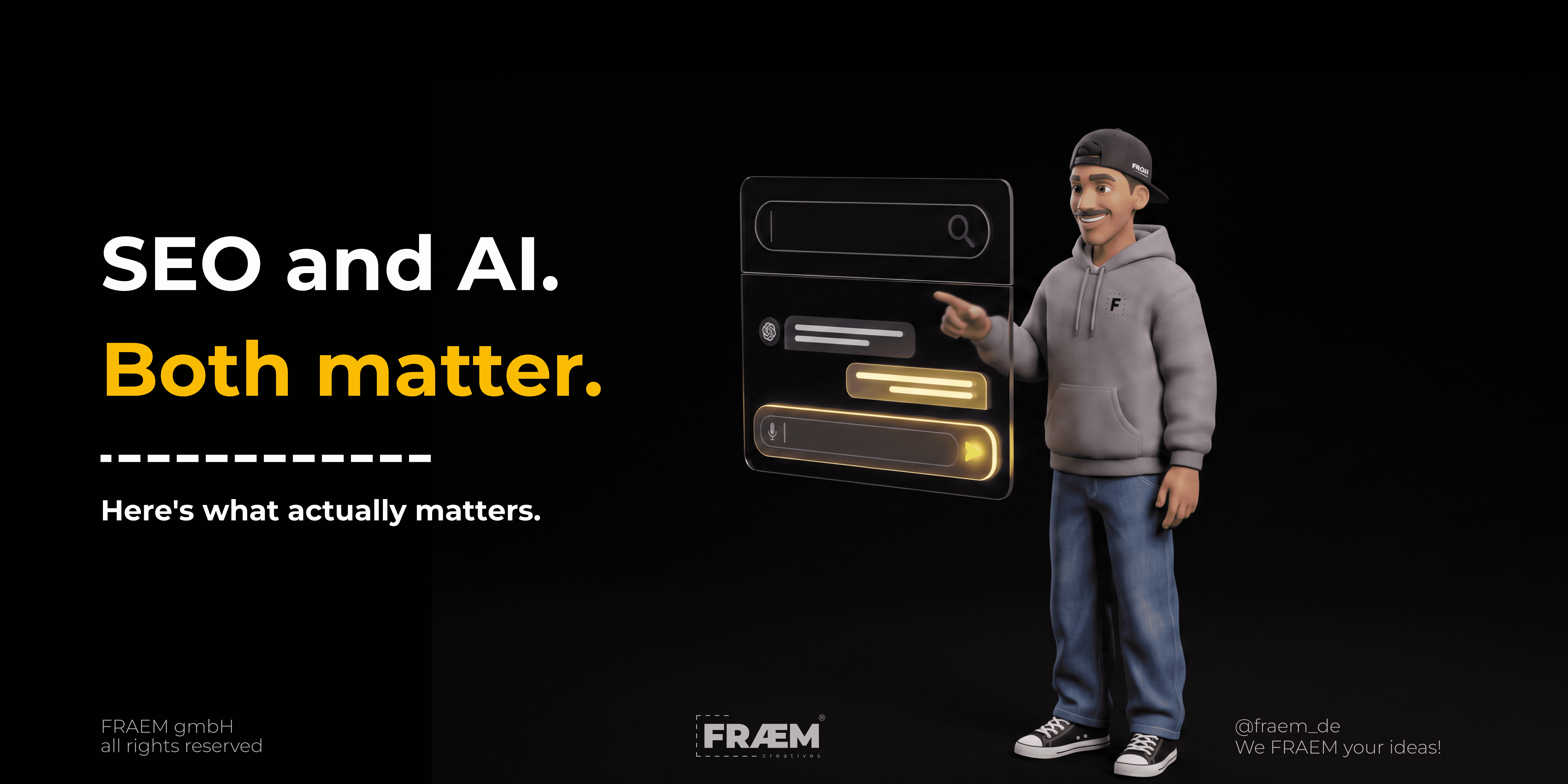
AI Search Is Here. SEO Isn't Dead. Here's What Matters.
43% of Germans use ChatGPT. Search is quietly changing under everyone's feet. Here's what's real, what's hype, and what your business should actually do about it.

Why Your Handwerk Website Isn't Doing Its Job
94% of German Handwerk businesses have a website. Only 3 of 500 audited sites came close to actually doing their job. Here's what "it works for us" is really costing you.

Framer vs. WordPress vs. TYPO3
Framer or WordPress for your Handwerk business? An honest comparison on cost, maintenance, and SEO. Plus when Webflow or TYPO3 actually makes sense.
How Handwerk Businesses Actually Find Azubis: 5 Steps
Finding Azubis and skilled workers in Handwerk: why job ads alone don't work and which five steps actually bring applications.
AI Search Is Here. SEO Isn't Dead. Here's What Matters.
43% of Germans use ChatGPT. Search is quietly changing under everyone's feet. Here's what's real, what's hype, and what your business should actually do about it.
Why Your Handwerk Website Isn't Doing Its Job
94% of German Handwerk businesses have a website. Only 3 of 500 audited sites came close to actually doing their job. Here's what "it works for us" is really costing you.
Framer vs. WordPress vs. TYPO3
Framer or WordPress for your Handwerk business? An honest comparison on cost, maintenance, and SEO. Plus when Webflow or TYPO3 actually makes sense.
Content that converts
(and doesn’t suck).
Let’s talk.
Content that converts
(and doesn’t suck).
Let’s talk.
Content that converts
(and doesn’t suck).
Let’s talk.


Nikkan & Soli Managing Directors
Nikkan & Soli Managing Directors
Nikkan & Soli Managing Directors