Framer or WordPress for your Handwerk business? An honest comparison on cost, maintenance, and SEO. Plus when Webflow or TYPO3 actually makes sense.

Read Time
7 min

Quick answer: For most Handwerk businesses, Framer is the better choice. It's faster to build, low-maintenance, and predictable in ongoing cost. WordPress only makes sense if you already have a developer in-house, need complex shop functionality, or manage more than 100 content pages.
Almost every serious conversation we have with a Handwerk business about their website ends up at the same fork in the road.
"Should we stick with WordPress (or TYPO3), or move to something like Framer?"
It's a fair question. And it's the kind of question that gets a lot of confident answers online from people who've never actually run a Handwerksbetrieb, never dealt with the reality of managing a website while also running a Baustelle, and never had to explain to a 55-year-old business owner why his website costs him money instead of making it.
So let's do this properly. Honest, specific to Handwerk, Bau, and Industrie businesses, and grounded in what we've actually seen after building dozens of websites across the sector.
No "it depends" cop-out at the end.

First, why this question even matters now
For most of the last 15 years, if you had a website in Germany, you had a WordPress site. It became the default not because it was the best option, but because it was the most available. Every freelancer knew it. Every Handwerkskammer training used it. Every "we'll build your website for €800" agency built on it.
That worked when the bar was low. A website was a digital business card. It sat there. It didn't have to do much.
That bar has moved. According to Bitkom's 2025 study on Handwerk digitalization, 94% of Handwerk businesses in Germany now have a website. Which means the "having one" phase is over. What matters now is whether your website actually works: winning customers, attracting candidates, supporting your sales process, and reflecting who you actually are as a business. We've written about the strategic side of this in more detail here.
That's where the platform question suddenly matters. Because the platform quietly decides what your website is capable of doing for your business.
So let's break down the two platforms most Handwerk businesses actually choose between.
What WordPress actually is
WordPress is an open-source content management system. That means it's free to download, you install it on your own server (or your hosting provider does), and you customize it with plugins and themes.
It powers roughly 40 to 43% of all websites on the internet. That's not marketing hype, that's just a fact. It's the largest CMS in the world by a huge margin.
Where WordPress genuinely shines:
You own everything. Your site, your data, your hosting choice. Nobody can lock you out.
The ecosystem is enormous. Whatever niche functionality you need, there's a plugin for it.
It's very good at complex content structures. Big blogs, news sites, sites with thousands of pages, WooCommerce shops with hundreds of products. WordPress handles this well.
It's flexible in a way no other platform is. If you have a developer, you can build almost anything.
Where WordPress gets you into trouble:
It requires ongoing maintenance. Core updates, plugin updates, security patches, backups. All of this has to happen or the site breaks or gets hacked.
The maintenance falls on you, or costs money. Most Handwerk businesses don't have the internal skills for this, so they either ignore it (until something breaks) or pay someone to handle it monthly.
Performance depends heavily on setup. A well-built WordPress site is fast. A typical WordPress site with 15 plugins and a bloated theme is slow.
Design consistency is fragile. Every plugin update or theme change can quietly break something. Small changes get complicated.
The Baukasten problem. Most Handwerk WordPress sites weren't built by developers. They were built with drag-and-drop themes like Divi, Elementor, or Astra. Those sites are usually SEO-weak, slow, and interchangeable.
The honest summary: WordPress is a powerful, professional tool. It works brilliantly when you have someone actively managing it. It becomes a slow-moving disaster when nobody does.
What Framer actually is
Framer is a modern web design and hosting platform. You design the site visually, similar to how you'd work in Figma. It hosts the site on its own global CDN. Updates, security, and infrastructure are handled automatically.
It's newer than WordPress. It's smaller than WordPress. And it's built for a completely different era of the web.
Where Framer genuinely shines:
Design and layout are fast. Really fast. What takes a WordPress developer a week can take a day in Framer.
Performance is excellent by default. Sites are static, delivered via CDN, and load fast without you having to think about it.
Zero maintenance burden. No plugin updates. No security patches. No server management. It just runs.
Changes are easy. You can update text, add a new section, or swap an image in minutes, without breaking anything.
The visual experience feels modern. Animations, transitions, and interactive elements are built in without needing custom code.
Good SEO out of the box. Clean URLs, fast page loads, proper structure. No SEO plugin gymnastics needed.
Where Framer has real limits:
It's less flexible for very complex content structures. If you have a massive blog with 500+ articles, complex categorization, or a full ecommerce store, WordPress or Webflow is better.
The ecosystem is smaller. Fewer integrations, fewer plugins, fewer third-party tools.
You don't own the infrastructure. You're renting from Framer. If they ever went out of business or changed their pricing dramatically, you'd have to migrate.
It's a subscription. Ongoing monthly cost, versus WordPress's "one-time payment plus hosting."
The editor interface is English-only. Your website content can be in any language, but the tool itself doesn't have a German UI.
The honest summary: Framer is a modern, fast, low-maintenance platform built for teams that want a great website without becoming website administrators. If you want to see how our Framer websites for Handwerk businesses look in practice, we're happy to show you.
The real reason we build in Framer
We could say "Framer is faster, cleaner, more modern." That's true, but it's not the main reason.
The main reason is what happens after the site launches.
A WordPress site is a project. It gets built, it goes live, and then someone has to keep it alive. Usually that someone is either overworked or nonexistent, and the site slowly degrades over a few years until it's back to being an outdated liability.
A Framer site is a working piece of infrastructure that stays working. We build it, hand it over, and our clients can actually use it without needing us on call. When they want to change something, they change it themselves in a few minutes. When they don't want to change anything, the site keeps running without asking for attention.
That's not a technical preference. That's a strategic preference. We want our clients' websites to keep serving their business years after we've finished the project. Framer makes that easy. WordPress makes it possible but requires ongoing investment.
For most Handwerk, Bau, and Industrie businesses we work with, the choice is obvious once you look at it that way.
The real question: what does your business actually need?
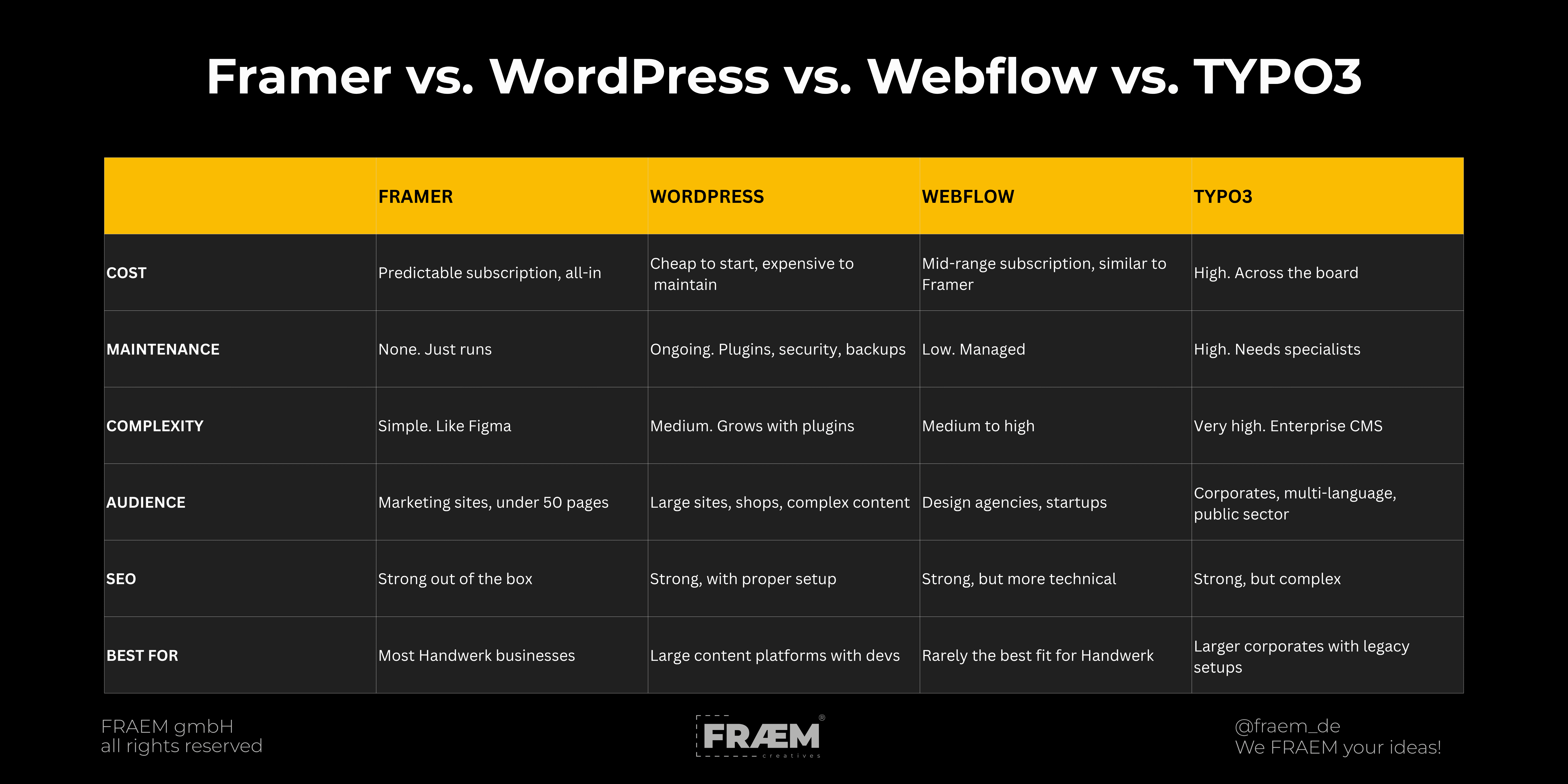
Now here's where most comparison articles fail. They give you a features table and say "it depends on your needs." Which is true but useless.
Let's be specific about what Handwerk businesses actually need from a website.
You need:
A site that shows up when local customers Google your trade
A career page that helps you attract skilled workers in a shrinking labor market
Enough visual credibility that a first-time visitor decides you're a professional operation
The ability to update content without calling someone every time
Something that runs without you having to think about it while you're on a Baustelle
You typically don't need:
A blog with 500+ articles
A complex WooCommerce shop with product configurators
Custom multi-language versions with regional variants
Advanced marketing automation baked into the CMS
Read those two lists again. This is the important part.
The stuff Handwerk businesses actually need is what Framer is really good at. The stuff Framer isn't great at is stuff most Handwerk businesses don't need.
That's why we build most Handwerk websites in Framer.
When WordPress is the right call
We're not going to tell you Framer is always the answer. It isn't. There are situations where WordPress genuinely is the better choice for a Handwerk business.
When WordPress makes sense:
You have a very large, content-heavy site. Hundreds of case studies, project pages, or blog posts.
You have a real developer on staff or a long-term technical partner who handles maintenance.
You need a proper online shop (WooCommerce) with product variants, complex pricing, or B2B ordering flows.
You need highly custom functionality that Framer doesn't support (specific integrations, custom user roles, complex forms with conditional logic).
Data ownership and self-hosting are non-negotiable for legal or strategic reasons.
If any of that describes your business, WordPress is probably the right platform. And done properly, it'll serve you well.
But here's the caveat: "done properly" means built by a developer, maintained regularly, and treated as a piece of infrastructure. If you were planning to have a freelancer set it up on a Divi theme and forget about it, you're going to end up with the same problem 78% of Handwerk websites already have. It'll exist. It won't work.
When Framer is the right call
For most Handwerk businesses we work with, Framer wins. Here's when we specifically recommend it:
You have a marketing-focused website: services, case studies, contact, career page. Under 50 pages, typically.
You want the site to look modern, fast, and professional without paying for a custom development project.
You need to update content occasionally (a few times a month) without breaking anything.
You don't want to think about maintenance, security, hosting, or updates.
You want the site to reflect a professional business, not a template.
That's most Handwerk businesses. Which is why we default to Framer unless there's a specific reason not to. You can see how this plays out in our case studies with Ab durch die Hecke, Maleco and N+F Wohnbau.
The maintenance question nobody talks about
Here's the argument that matters most and gets discussed least.
WordPress is powerful. Framer is simpler. That's true. But that framing misses the real cost picture.
A WordPress site has ongoing maintenance costs. Someone needs to:
Update the core WordPress installation regularly
Update plugins (some of which occasionally break your site)
Handle security patches
Manage backups
Monitor uptime
Fix things when they break
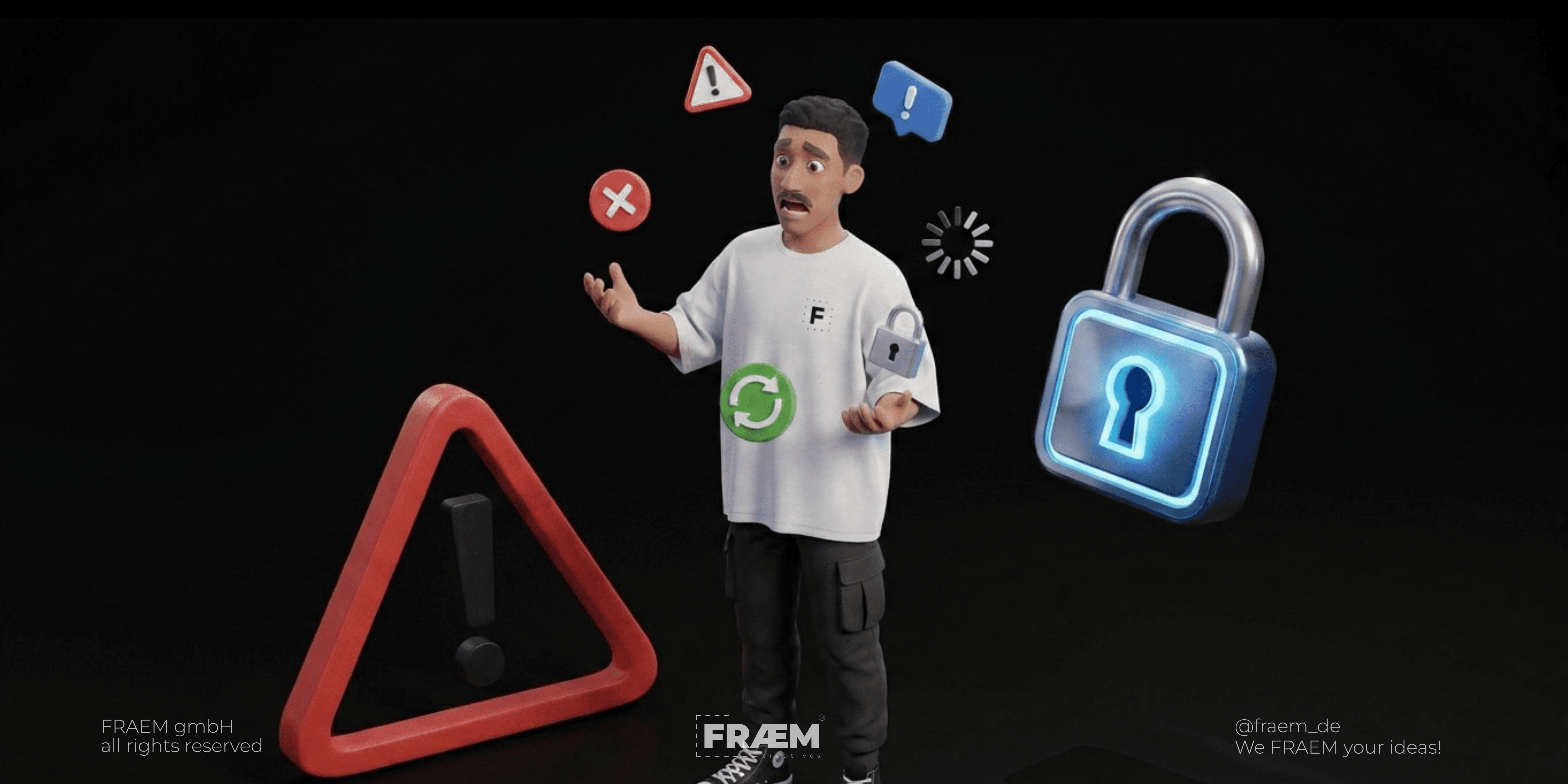
If you have an internal team or a monthly retainer with a developer, this is fine. If you don't, you're either paying every time something goes wrong (which is expensive and stressful) or ignoring it (which is worse).
A Framer site has none of this. The maintenance is included in the subscription. The platform handles updates, security, and hosting. Your monthly cost is predictable. You never get a surprise invoice because a plugin conflict took the site offline.
For a professional Handwerk business that's already spread thin between projects, staff, and administration, that predictability is worth a lot. Probably more than most owners realize until they've been on both sides of it.
What about Webflow?
Fair question. Webflow is the third platform people ask about, so let's address it honestly.
Webflow is a solid platform. It sits somewhere between Framer and WordPress in terms of flexibility versus simplicity. It's more powerful than Framer for complex CMS structures. It's easier to maintain than WordPress.
But in our experience, it's rarely the right fit for Handwerk businesses specifically. It's more complex than Framer without offering meaningful benefits for the typical Handwerk use case. And its ecosystem in Germany is smaller than WordPress's, so if you ever need help, you'll find fewer local partners.
Webflow shines for design agencies, tech startups, and companies with dedicated in-house web teams. For a Handwerksbetrieb, it's usually more platform than you need, and the learning curve doesn't pay off.
That's our honest read. Not "it's bad." Just "it's rarely the right tool for this specific job."
And what about TYPO3?
This one's more relevant for our market than most comparison articles admit. TYPO3 is the second-most-used CMS in Germany, holding around 13% of the market compared to WordPress's roughly 46%. It has almost no presence internationally, but it's genuinely common in German B2B and Mittelstand websites, especially for larger, older, and more established Bau and Industrie companies.
If you inherited your website from an agency in the early 2010s, there's a decent chance it's built on TYPO3.
Where TYPO3 has real strengths:
Built from the start as an "Enterprise CMS" for large, complex sites with multi-language, multi-region, and multi-department content structures.
Excellent multilingual support built in. If you operate across DACH or across EU markets, TYPO3 handles this without needing extra plugins.
Strong reputation for security and data protection. Popular with public sector, banks, and larger corporations for exactly this reason.
Deep permission and workflow systems for large teams with different editor roles.
Where TYPO3 becomes a problem for most Handwerk businesses:
It's complex. Really complex. The learning curve for editors is significantly steeper than WordPress, let alone Framer.
The developer and agency community is smaller and getting smaller. Finding someone who can update or maintain a TYPO3 site is harder every year, and usually more expensive.
It's overkill for what most Handwerk businesses need. You're paying for enterprise-grade complexity to run a 20-page marketing site.
Costs are typically higher across the board. Development, maintenance, hosting, and updates all tend to run more than WordPress for equivalent scope.
The honest read on TYPO3 for Handwerk:
If you already have a working TYPO3 site with a reliable partner maintaining it and you have multi-language, multi-region, or serious content complexity, keeping it can make sense. Migrations away from TYPO3 are usually painful, and if the existing site works, that's worth something.
But if you're starting fresh, or your TYPO3 site is showing its age and the original agency is nowhere to be found, we'd almost never recommend building a new Handwerk website on TYPO3 in 2026. The complexity-to-benefit ratio doesn't work for a typical Handwerk operation. Framer or a well-built WordPress site will serve you better with a fraction of the ongoing pain.
We've migrated Handwerk businesses off TYPO3 to Framer more times than in the other direction. That trend isn't slowing down.
How to actually decide
Forget the feature comparisons for a minute. Ask yourself these five questions.
Do you have someone on your team or on retainer who can actively maintain a WordPress site every month?
Do you need functionality that only WordPress offers (large shop, complex CMS, custom development)?
Are you okay with predictable monthly costs, or do you need a one-time payment model?
Is your priority moving fast and looking professional, or maximum flexibility long-term?
Do you want to think about your website regularly, or do you want it to just work?
If your answers are "no, no, monthly is fine, moving fast, just work," Framer is your answer.
If your answers are "yes, yes, one-time payment, maximum flexibility, I'll manage it," WordPress is your answer.
For most Handwerk businesses we've worked with, the first list applies. Which is why we default to Framer.
One more thing.
We're not selling you a platform. We're pointing at a reality that's rarely discussed honestly.
Choosing the platform is not just a technical decision. It's a decision about how much of your future attention your website will demand. WordPress demands ongoing attention. Framer demands very little. That's the real trade-off, and it's the one that matters most when you're running a business that's already busy. If you're interested in the bigger marketing picture, we've written about Marketing for Trades, Construction and Industry in more detail.
If you're not sure which side of that decision your business is on, we're happy to have a real conversation about it. No pressure to migrate. No sales pitch. Just an honest read on what makes sense for where your business actually is.
Frequently Asked Questions!
Isn't WordPress cheaper than Framer?
Upfront, yes. Long-term, usually not. WordPress requires ongoing maintenance (updates, security, hosting, occasional developer fixes) that most Handwerk businesses either pay for monthly or eventually pay for all at once when something breaks. Framer's subscription includes all of that. Over a 3 to 5 year period, total cost is often similar, sometimes lower with Framer.
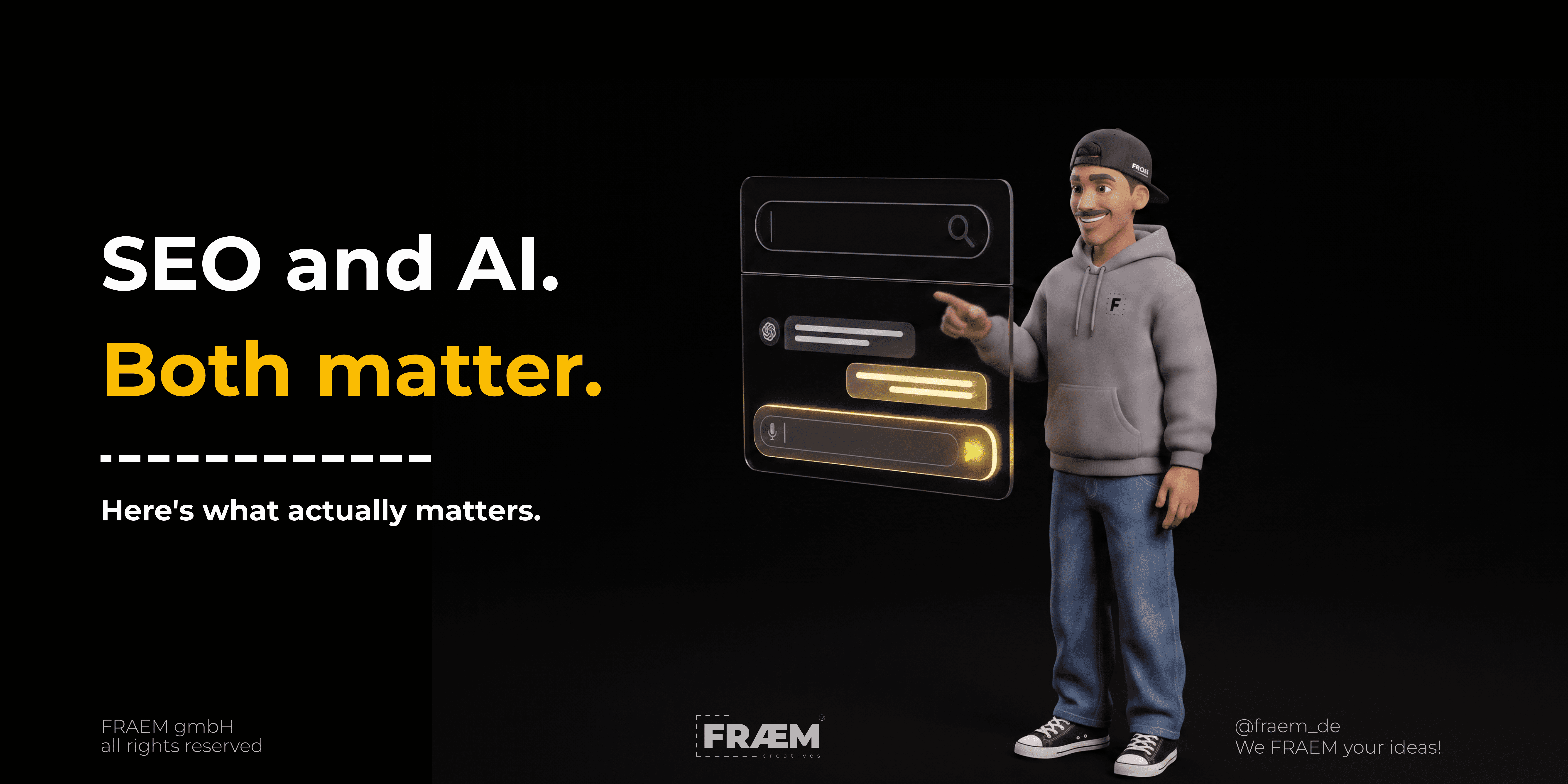
AI Search Is Here. SEO Isn't Dead. Here's What Matters.
43% of Germans use ChatGPT. Search is quietly changing under everyone's feet. Here's what's real, what's hype, and what your business should actually do about it.

Why Your Handwerk Website Isn't Doing Its Job
94% of German Handwerk businesses have a website. Only 3 of 500 audited sites came close to actually doing their job. Here's what "it works for us" is really costing you.

Sales vs. Marketing: Who's Actually Right?
The classic sales vs. marketing argument is rarely about who's right. It's usually about a disconnect nobody wants to name. Here's how to spot it, and how to fix it.