Phase 01 - Explore
Phase 01 - Explore
Brand & Positioning:
why people choose you.
A position is not a claim and not a wording workshop. It is the decision about who you are for, which alternative you are up against, and how anyone would notice the difference. We write it, we evidence it, and we test it on real people before you put it everywhere.
A position is not a claim and not a wording workshop. It is the decision about who you are for, which alternative you are up against, and how anyone would notice the difference. We write it, we evidence it, and we test it on real people before you put it everywhere.
Definition line
Brand positioning defines what place a brand should hold in the mind of a specific audience and what sets it apart from competitors. It has to be something the company can actually deliver. The result is a sentence you decide by.
Brand positioning defines what place a brand should hold in the mind of a specific audience and what sets it apart from competitors. It has to be something the company can actually deliver. The result is a sentence you decide by.
Brand positioning defines what place a brand should hold in the mind of a specific audience and what sets it apart from competitors. It has to be something the company can actually deliver. The result is a sentence you decide by.
Scope
What is included


Your positioning sits in a document nobody quotes.
In a sales conversation everyone still explains off the cuff what you actually do.
Five people from your team, five different answers.
To the question of what you do differently. And none of the five is wrong.
You keep losing on price.
Not because you are too expensive, but because the customer was never offered anything else to compare on.
The analysis is done, the decision is not.
The numbers and the conversations are there, but nobody has turned them into a position anyone can defend.
Problem List
This is for you if
"If your strongest competitor could sign the same sentence, it isn't a position."
"If your strongest competitor could sign the same sentence, it isn't a position."
"If your strongest competitor could sign the same sentence, it isn't a position."






Frequently Asked
Frequently Asked
Questions
Questions
What is positioning exactly, and what does it give us?
Positioning is a decision, not a wording exercise. You settle who you are for, which alternative you are up against, and what the difference is. The result is one sentence with evidence behind it, not three nobody remembers.
The most common mistake is confusing positioning with a claim. A claim is a sentence you say outwards. A position is a sentence you decide by internally, and it often appears nowhere on the website. A good position can turn into a claim later. It does not work the other way round.
In German the same work runs under Markenpositionierung or Positionierungsstrategie, and in sales usually as the question about your Alleinstellungsmerkmal. It is the same job asked from different directions.
The benefit rarely shows up where you expect it. Fastest in sales, because everyone finally says the same thing. Then in internal decisions, because there is now a standard to check them against instead of arguing them out. And last in marketing, because briefings get shorter once the direction is already settled.
Framer is a web builder for creative pros. Be sure to check out framer.com to learn more.
Positioning is a decision, not a wording exercise. You settle who you are for, which alternative you are up against, and what the difference is. The result is one sentence with evidence behind it, not three nobody remembers.
The most common mistake is confusing positioning with a claim. A claim is a sentence you say outwards. A position is a sentence you decide by internally, and it often appears nowhere on the website. A good position can turn into a claim later. It does not work the other way round.
In German the same work runs under Markenpositionierung or Positionierungsstrategie, and in sales usually as the question about your Alleinstellungsmerkmal. It is the same job asked from different directions.
The benefit rarely shows up where you expect it. Fastest in sales, because everyone finally says the same thing. Then in internal decisions, because there is now a standard to check them against instead of arguing them out. And last in marketing, because briefings get shorter once the direction is already settled.
We already have a positioning. Is that not enough?
Depends on whether it gets used. The test takes ten minutes: ask five people from your team what sets you apart from the competition, and compare the answers. If they diverge, the positioning exists on paper but not in daily work.
That is rarely because it is wrong. Two causes come up almost every time. Either the evidence is missing, in which case the statement is a claim and nobody dares defend it in a sales conversation. Or it is worded so generally that any competitor could sign the same sentence, and then it is not wrong, just not useful.
Both are fixable without starting over. If the direction is right and only the proof is missing, that is a sharpening rather than a repositioning, and the effort is correspondingly lower.
A third case is more common than people think: the positioning is good, but nobody knows it. It sits in a document presented once two years ago, and since then half the team has turned over. The five-person test shows that too, and the fix then is not the positioning itself but what comes after it.
Framer is a web builder for creative pros. Be sure to check out framer.com to learn more.
Depends on whether it gets used. The test takes ten minutes: ask five people from your team what sets you apart from the competition, and compare the answers. If they diverge, the positioning exists on paper but not in daily work.
That is rarely because it is wrong. Two causes come up almost every time. Either the evidence is missing, in which case the statement is a claim and nobody dares defend it in a sales conversation. Or it is worded so generally that any competitor could sign the same sentence, and then it is not wrong, just not useful.
Both are fixable without starting over. If the direction is right and only the proof is missing, that is a sharpening rather than a repositioning, and the effort is correspondingly lower.
A third case is more common than people think: the positioning is good, but nobody knows it. It sits in a document presented once two years ago, and since then half the team has turned over. The five-person test shows that too, and the fix then is not the positioning itself but what comes after it.
When is the right moment to work on positioning?
When the audit and the analysis are done and the decision is missing. Or when you notice the market cannot tell you apart, however good the work is.
The clearest sign is price. You keep losing on price, not because you are too expensive, but because the customer was never offered anything else to compare on. Where no difference is visible, the only comparable number decides.
Other triggers: a rebrand is coming and the discussion about what changes runs on taste rather than evidence. You sound like everyone else in your field and you can hear it yourself. Five people from the team give five different answers to what makes you special, and none of them is wrong. Or the numbers from the market analysis are on the table and nobody has turned them into a position anyone can defend.
It is too early if you do not yet have clarity about your own offer. Positioning cannot tidy up an unclear business model, it only makes the lack of clarity more visible. In that case we say so and start somewhere else.
Framer is a web builder for creative pros. Be sure to check out framer.com to learn more.
When the audit and the analysis are done and the decision is missing. Or when you notice the market cannot tell you apart, however good the work is.
The clearest sign is price. You keep losing on price, not because you are too expensive, but because the customer was never offered anything else to compare on. Where no difference is visible, the only comparable number decides.
Other triggers: a rebrand is coming and the discussion about what changes runs on taste rather than evidence. You sound like everyone else in your field and you can hear it yourself. Five people from the team give five different answers to what makes you special, and none of them is wrong. Or the numbers from the market analysis are on the table and nobody has turned them into a position anyone can defend.
It is too early if you do not yet have clarity about your own offer. Positioning cannot tidy up an unclear business model, it only makes the lack of clarity more visible. In that case we say so and start somewhere else.
What exactly does FRAEM do?
Three things: the positioning statement itself, the framework holding the evidence behind it, and the story of the category that statement wins in.
Positioning statement. Who you are for, which alternative you are up against, and what the difference is. One sentence that contains a decision. If it fits everyone, it is not a position, it is a description.
Differentiation framework. What the difference can be pinned to, point by point: what you do, how you work, what proves it, where it ends. This is the part that carries the claim in a sales conversation when a competitor says the same thing, and the part most agencies leave out.
Category narrative. The story of the category you sell in, told by you rather than by somebody else. Most companies position themselves inside a category a competitor or a trade magazine defined, and inherit those standards along with it. Whoever describes the category sets what the market measures quality by. That sounds abstract and is very practical: it decides who you get compared against at all, which often matters more than the comparison itself.
Framer is a web builder for creative pros. Be sure to check out framer.com to learn more.
Three things: the positioning statement itself, the framework holding the evidence behind it, and the story of the category that statement wins in.
Positioning statement. Who you are for, which alternative you are up against, and what the difference is. One sentence that contains a decision. If it fits everyone, it is not a position, it is a description.
Differentiation framework. What the difference can be pinned to, point by point: what you do, how you work, what proves it, where it ends. This is the part that carries the claim in a sales conversation when a competitor says the same thing, and the part most agencies leave out.
Category narrative. The story of the category you sell in, told by you rather than by somebody else. Most companies position themselves inside a category a competitor or a trade magazine defined, and inherit those standards along with it. Whoever describes the category sets what the market measures quality by. That sounds abstract and is very practical: it decides who you get compared against at all, which often matters more than the comparison itself.
Want to learn more about us? Check out our entire FAQ!
Want to learn more about us? Check out our entire FAQ!
Interested in Content Marketing?
Check out our most recent articles!
Interested in Content Marketing?
Check out our most recent articles!

How Handwerk Businesses Actually Find Azubis: 5 Steps
Finding Azubis and skilled workers in Handwerk: why job ads alone don't work and which five steps actually bring applications.
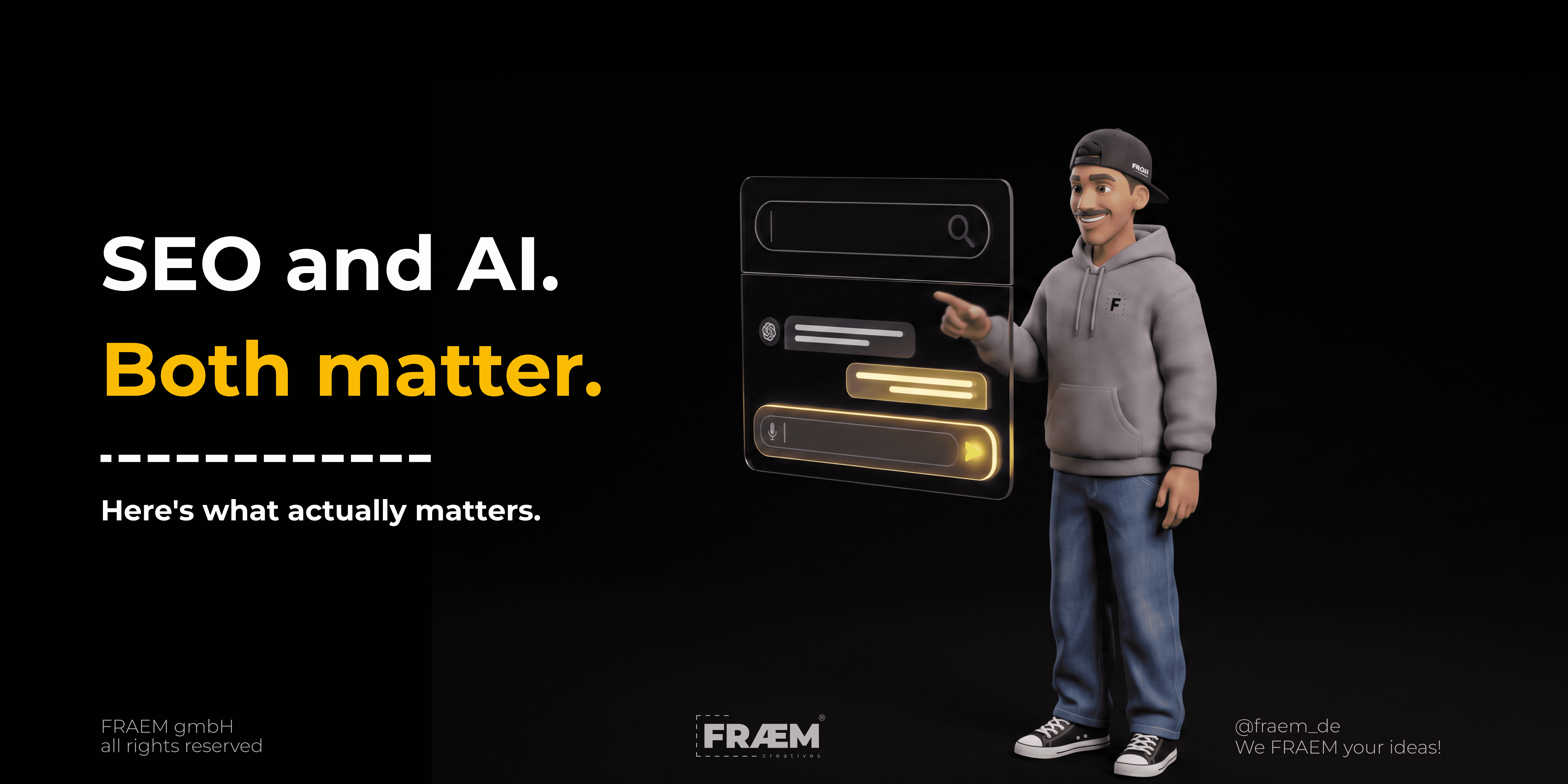
AI Search Is Here. SEO Isn't Dead. Here's What Matters.
43% of Germans use ChatGPT. Search is quietly changing under everyone's feet. Here's what's real, what's hype, and what your business should actually do about it.

Why Your Handwerk Website Isn't Doing Its Job
94% of German Handwerk businesses have a website. Only 3 of 500 audited sites came close to actually doing their job. Here's what "it works for us" is really costing you.

Framer vs. WordPress vs. TYPO3
Framer or WordPress for your Handwerk business? An honest comparison on cost, maintenance, and SEO. Plus when Webflow or TYPO3 actually makes sense.
How Handwerk Businesses Actually Find Azubis: 5 Steps
Finding Azubis and skilled workers in Handwerk: why job ads alone don't work and which five steps actually bring applications.
AI Search Is Here. SEO Isn't Dead. Here's What Matters.
43% of Germans use ChatGPT. Search is quietly changing under everyone's feet. Here's what's real, what's hype, and what your business should actually do about it.
Why Your Handwerk Website Isn't Doing Its Job
94% of German Handwerk businesses have a website. Only 3 of 500 audited sites came close to actually doing their job. Here's what "it works for us" is really costing you.
Framer vs. WordPress vs. TYPO3
Framer or WordPress for your Handwerk business? An honest comparison on cost, maintenance, and SEO. Plus when Webflow or TYPO3 actually makes sense.
Content that converts
(and doesn’t suck).
Let’s talk.
Content that converts
(and doesn’t suck).
Let’s talk.
Content that converts
(and doesn’t suck).
Let’s talk.


Nikkan & Soli Managing Directors
Nikkan & Soli Managing Directors
Nikkan & Soli Managing Directors