Phase 02 - Shape
Phase 02 - Shape
Employer Branding:
Visible to the people you need.
The roles stay open and the employer brand is a tab on the website. We turn what working with you is actually like into a position people can see: in job ads, on career pages, in the channels your people actually use.
The roles stay open and the employer brand is a tab on the website. We turn what working with you is actually like into a position people can see: in job ads, on career pages, in the channels your people actually use.
Definition line
Employer branding is building and maintaining a company as an employer brand: outward, to attract applicants, inward, to keep the people already there. It rests on a promise that daily work actually delivers.
Employer branding is building and maintaining a company as an employer brand: outward, to attract applicants, inward, to keep the people already there. It rests on a promise that daily work actually delivers.
Employer branding is building and maintaining a company as an employer brand: outward, to attract applicants, inward, to keep the people already there. It rests on a promise that daily work actually delivers.
Scope
What is included


Problem List
This is for you if
Roles stay open even though you are advertising.
The ads are running, the applications are not coming, and nobody internally can say why.
Your careers page could belong to any company.
Team photo, fruit basket, flat hierarchies. The others say the same, so in the end salary decides.
You know it is good with you, but you do not say it.
What working with you is like is known only to the people already there. None of it reaches the outside.
Every department recruits on its own.
Sales, engineering and production show up differently, and applicants see three different companies.
Reference


What that looked like at Godelmann.
What that looked like at Godelmann.
Make apprenticeships visible to young people who do not read job ads.
Make apprenticeships visible to young people who do not read job ads.
Instead of advertising roles, we showed the people behind them: apprentices, departments, locations, filmed in a tight production window and cut for Instagram and TikTok. The campaign ran in three stages, from first attention to application.
Instead of advertising roles, we showed the people behind them: apprentices, departments, locations, filmed in a tight production window and cut for Instagram and TikTok. The campaign ran in three stages, from first attention to application.
Recruiting-Strategie
Plattform-Strategie
Content-Produktion
"An employer brand that gets disproved in the first month has only made the resignation arrive sooner."
"An employer brand that gets disproved in the first month has only made the resignation arrive sooner."
"An employer brand that gets disproved in the first month has only made the resignation arrive sooner."






How visibility happens
How visibility happens
How you reach people who are not looking
How you reach people who are not looking
Most good people do not read job ads, because right now they have no reason to. That is why a recruiting campaign runs in three stages and not in one.
Most good people do not read job ads, because right now they have no reason to. That is why a recruiting campaign runs in three stages and not in one.
1
Attention
They know you exist.
First someone has to notice you exist at all. Content at this stage does not sell a role, it shows the company and the people in it. What gets measured here is reach in the right group, not applications.
1
Attention
They know you exist.
First someone has to notice you exist at all. Content at this stage does not sell a role, it shows the company and the people in it. What gets measured here is reach in the right group, not applications.
2
Understanding
They know what the work is like.
Then it has to become clear what the work actually is: the daily routine, the tasks, the colleagues. This is the stage that is missing most often, and the reason campaigns produce reach and still no applications.
2
Understanding
They know what the work is like.
Analysis, concept, production or evaluation, depending on the phase. Whatever comes out, we sort it before you see it. Not every inconsistency is a problem, and not every finding matters equally. You get what counts, not all of it. We need nothing from you.
3
Application
They know what to do.
Only at the end come the concrete details: which roles, which requirements, how to apply. Starting here means talking only to the few who are already looking.
3
Application
They know what to do.
Whether it is a workshop, feedback round or review call depends on the phase. Who decides does not. What we have is on the table, the options get tested, and the direction is set by those who will defend it internally.
Frequently Asked
Frequently Asked
Questions
Questions
What is employer branding?
Employer branding is building and maintaining a company as an employer brand. Outward, to attract applicants, inward, to keep the people already there. At its core is a promise that actually gets delivered.
The second part is where it usually fails. An employer brand is not a statement about the company but a perception in other people, and perception comes from experience, not from ads.
Promising flexibility and then demanding presence does not give you a weak campaign, it gives you a disproved one. So we do not start with the message but with what people actually experience with you. Anything that cannot be evidenced is not usable as a promise, however good it sounds. That is uncomfortable while working on it and the reason the result holds up later.
The side effect usually gets overlooked: half the impact happens with the people already there. Someone reading for the first time, in plain words, why their own company is a good place tends to pass that on, and referrals from the team are the cheapest source of good applications there is.
Framer is a web builder for creative pros. Be sure to check out framer.com to learn more.
Employer branding is building and maintaining a company as an employer brand. Outward, to attract applicants, inward, to keep the people already there. At its core is a promise that actually gets delivered.
The second part is where it usually fails. An employer brand is not a statement about the company but a perception in other people, and perception comes from experience, not from ads.
Promising flexibility and then demanding presence does not give you a weak campaign, it gives you a disproved one. So we do not start with the message but with what people actually experience with you. Anything that cannot be evidenced is not usable as a promise, however good it sounds. That is uncomfortable while working on it and the reason the result holds up later.
The side effect usually gets overlooked: half the impact happens with the people already there. Someone reading for the first time, in plain words, why their own company is a good place tends to pass that on, and referrals from the team are the cheapest source of good applications there is.
What is the difference between employer branding, personnel marketing and recruiting?
Employer branding builds the employer brand. Personnel marketing speaks to candidate audiences. Recruiting fills the specific role. We do the first two and the campaigns for them; the filling itself is done by you or your recruiter.
This is not small print, it decides whether a project helps at all. We do not screen applications, do not run interviews and do not work inside your applicant system. What we deliver is the reason someone applies in the first place, and the visibility for it.
If your roles stay open because the process takes three weeks to a first reply, or because rejections never go out, that is a recruiting problem and not a brand problem. We say so in the first conversation, because a brand project will not fix it and will still cost money. The reverse holds too: if you already work with a recruiter, we do not replace them, we give them material to work with.
A clear position makes outreach by a third party considerably easier, because the conversation is then no longer about salary alone.
Framer is a web builder for creative pros. Be sure to check out framer.com to learn more.
Employer branding builds the employer brand. Personnel marketing speaks to candidate audiences. Recruiting fills the specific role. We do the first two and the campaigns for them; the filling itself is done by you or your recruiter.
This is not small print, it decides whether a project helps at all. We do not screen applications, do not run interviews and do not work inside your applicant system. What we deliver is the reason someone applies in the first place, and the visibility for it.
If your roles stay open because the process takes three weeks to a first reply, or because rejections never go out, that is a recruiting problem and not a brand problem. We say so in the first conversation, because a brand project will not fix it and will still cost money. The reverse holds too: if you already work with a recruiter, we do not replace them, we give them material to work with.
A clear position makes outreach by a third party considerably easier, because the conversation is then no longer about salary alone.
We just need more applications. Does this help?
More applications are easy to get: advertise wider, lower the requirements, raise the budget. The question is whether you want more or better matched. Those are two different projects with two different invoices.
With most companies we speak to, the problem is not the number but the hit rate. Twenty applications where none fit cost more time than five where two fit, because every single one has to be read and answered. A clear employer position works in both directions: it attracts the right people and deters the wrong ones.
Nobody ever orders the second effect, and in the arithmetic it is often the more valuable one, because it saves time in a department that already has too little. There is also the case where the number really is missing, namely for roles hardly anybody knows or actively searches for. Then it is about visibility in channels outside the job boards, and that is exactly what the recruiting campaigns are for. Which of the two applies to you shows in the numbers from your last postings.
Framer is a web builder for creative pros. Be sure to check out framer.com to learn more.
More applications are easy to get: advertise wider, lower the requirements, raise the budget. The question is whether you want more or better matched. Those are two different projects with two different invoices.
With most companies we speak to, the problem is not the number but the hit rate. Twenty applications where none fit cost more time than five where two fit, because every single one has to be read and answered. A clear employer position works in both directions: it attracts the right people and deters the wrong ones.
Nobody ever orders the second effect, and in the arithmetic it is often the more valuable one, because it saves time in a department that already has too little. There is also the case where the number really is missing, namely for roles hardly anybody knows or actively searches for. Then it is about visibility in channels outside the job boards, and that is exactly what the recruiting campaigns are for. Which of the two applies to you shows in the numbers from your last postings.
Who has to take part, and where does the content come from?
From conversations with your people. Eight to twelve, across departments and levels of experience, and explicitly including people who are not currently enthusiastic. Plus one person allowed to decide, usually from HR or the management.
Why not only the happiest: a position built purely from praise does not survive an interview, because that is exactly what candidates probe. The usable sentences almost always come from people who also see something critically, because they name what is genuinely different about you rather than what is nice. The conversations are confidential, we pass on no names, and we tell participants that beforehand. Without that assurance you get politeness instead of material, and politeness sounds the same at every company.
The time cost to you is small: under an hour per person, scheduled around your calendar. What costs more is the willingness to accept the result even when it is not what the management expected. That happens more often than people think, and it is usually the better news.
Framer is a web builder for creative pros. Be sure to check out framer.com to learn more.
From conversations with your people. Eight to twelve, across departments and levels of experience, and explicitly including people who are not currently enthusiastic. Plus one person allowed to decide, usually from HR or the management.
Why not only the happiest: a position built purely from praise does not survive an interview, because that is exactly what candidates probe. The usable sentences almost always come from people who also see something critically, because they name what is genuinely different about you rather than what is nice. The conversations are confidential, we pass on no names, and we tell participants that beforehand. Without that assurance you get politeness instead of material, and politeness sounds the same at every company.
The time cost to you is small: under an hour per person, scheduled around your calendar. What costs more is the willingness to accept the result even when it is not what the management expected. That happens more often than people think, and it is usually the better news.
Want to learn more about us? Check out our entire FAQ!
Want to learn more about us? Check out our entire FAQ!
Across the company: Eight to twelve conversations, including people who are not enthusiastic.
Across the company: Eight to twelve conversations, including people who are not enthusiastic.
An early no: If communication is not the problem, we say so in the first call.
An early no: If communication is not the problem, we say so in the first call.
Applications, not views: How success is measured is agreed before the start, not after.
Applications, not views: How success is measured is agreed before the start, not after.
Why choose FRÆM for your employer brand?
Why choose FRÆM for your employer brand?
Across the company: Eight to twelve conversations, including people who are not enthusiastic.
Across the company: Eight to twelve conversations, including people who are not enthusiastic.
An early no: If communication is not the problem, we say so in the first call.
An early no: If communication is not the problem, we say so in the first call.
Applications, not views: How success is measured is agreed before the start, not after.
Applications, not views: How success is measured is agreed before the start, not after.
Interested in Content Marketing?
Check out our most recent articles!
Interested in Content Marketing?
Check out our most recent articles!

How Handwerk Businesses Actually Find Azubis: 5 Steps
Finding Azubis and skilled workers in Handwerk: why job ads alone don't work and which five steps actually bring applications.
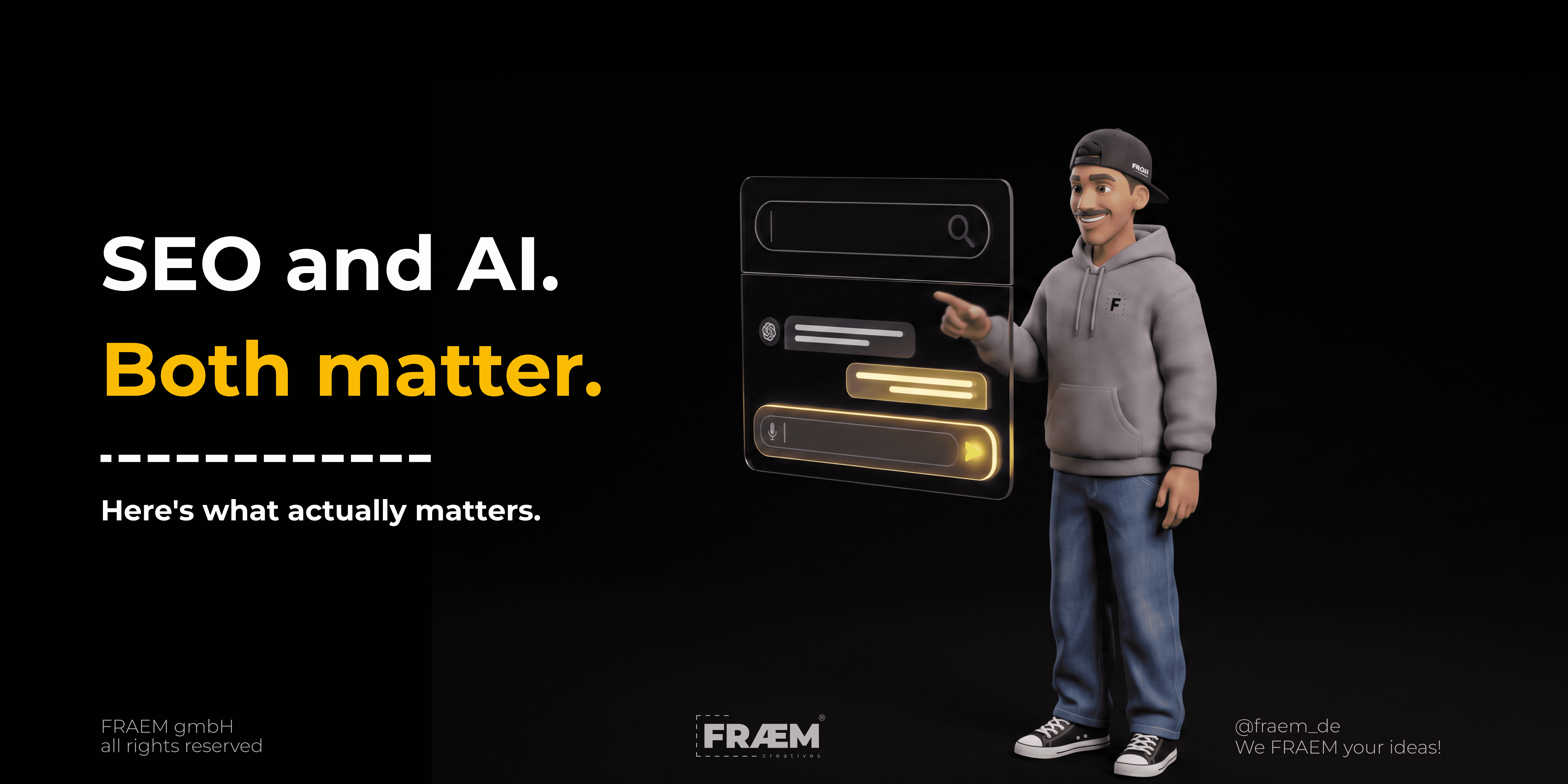
AI Search Is Here. SEO Isn't Dead. Here's What Matters.
43% of Germans use ChatGPT. Search is quietly changing under everyone's feet. Here's what's real, what's hype, and what your business should actually do about it.

Why Your Handwerk Website Isn't Doing Its Job
94% of German Handwerk businesses have a website. Only 3 of 500 audited sites came close to actually doing their job. Here's what "it works for us" is really costing you.

Framer vs. WordPress vs. TYPO3
Framer or WordPress for your Handwerk business? An honest comparison on cost, maintenance, and SEO. Plus when Webflow or TYPO3 actually makes sense.
How Handwerk Businesses Actually Find Azubis: 5 Steps
Finding Azubis and skilled workers in Handwerk: why job ads alone don't work and which five steps actually bring applications.
AI Search Is Here. SEO Isn't Dead. Here's What Matters.
43% of Germans use ChatGPT. Search is quietly changing under everyone's feet. Here's what's real, what's hype, and what your business should actually do about it.
Why Your Handwerk Website Isn't Doing Its Job
94% of German Handwerk businesses have a website. Only 3 of 500 audited sites came close to actually doing their job. Here's what "it works for us" is really costing you.
Framer vs. WordPress vs. TYPO3
Framer or WordPress for your Handwerk business? An honest comparison on cost, maintenance, and SEO. Plus when Webflow or TYPO3 actually makes sense.
Content that converts
(and doesn’t suck).
Let’s talk.
Content that converts
(and doesn’t suck).
Let’s talk.
Content that converts
(and doesn’t suck).
Let’s talk.


Nikkan & Soli Managing Directors
Nikkan & Soli Managing Directors
Nikkan & Soli Managing Directors