The classic sales vs. marketing argument is rarely about who's right. It's usually about a disconnect nobody wants to name. Here's how to spot it, and how to fix it.

Read Time
7 min

You know this meeting. Marketing presents the quarterly numbers. Reach is up. Engagement is up. The campaign performed above benchmark. The website traffic is climbing. Everyone in the marketing team is quietly proud.
Then someone from sales speaks up. "That's great. But none of this is hitting our pipeline. The leads we're getting are unqualified. The MQLs sit there. We're burning time on conversations that go nowhere. And honestly? Half of our actual customers came from referrals or trade fairs, not from any of this."
The room goes quiet. Or worse, it doesn't. The argument starts. Marketing pulls up dashboards. Sales pulls up stories. Both sides leave the meeting more frustrated than they came in.
If you've sat in this meeting, you're not alone. We see this almost every time we work with a company in trades, construction, or industry that has both functions operating at scale. And here's what we've come to believe after years of watching it play out: the question of who's right is almost never the right question. The interesting question is why the disconnect exists in the first place.
Because the disconnect itself is the problem. Not the metrics. Not the campaigns. Not the leads. The disconnect.

Why this happens almost everywhere
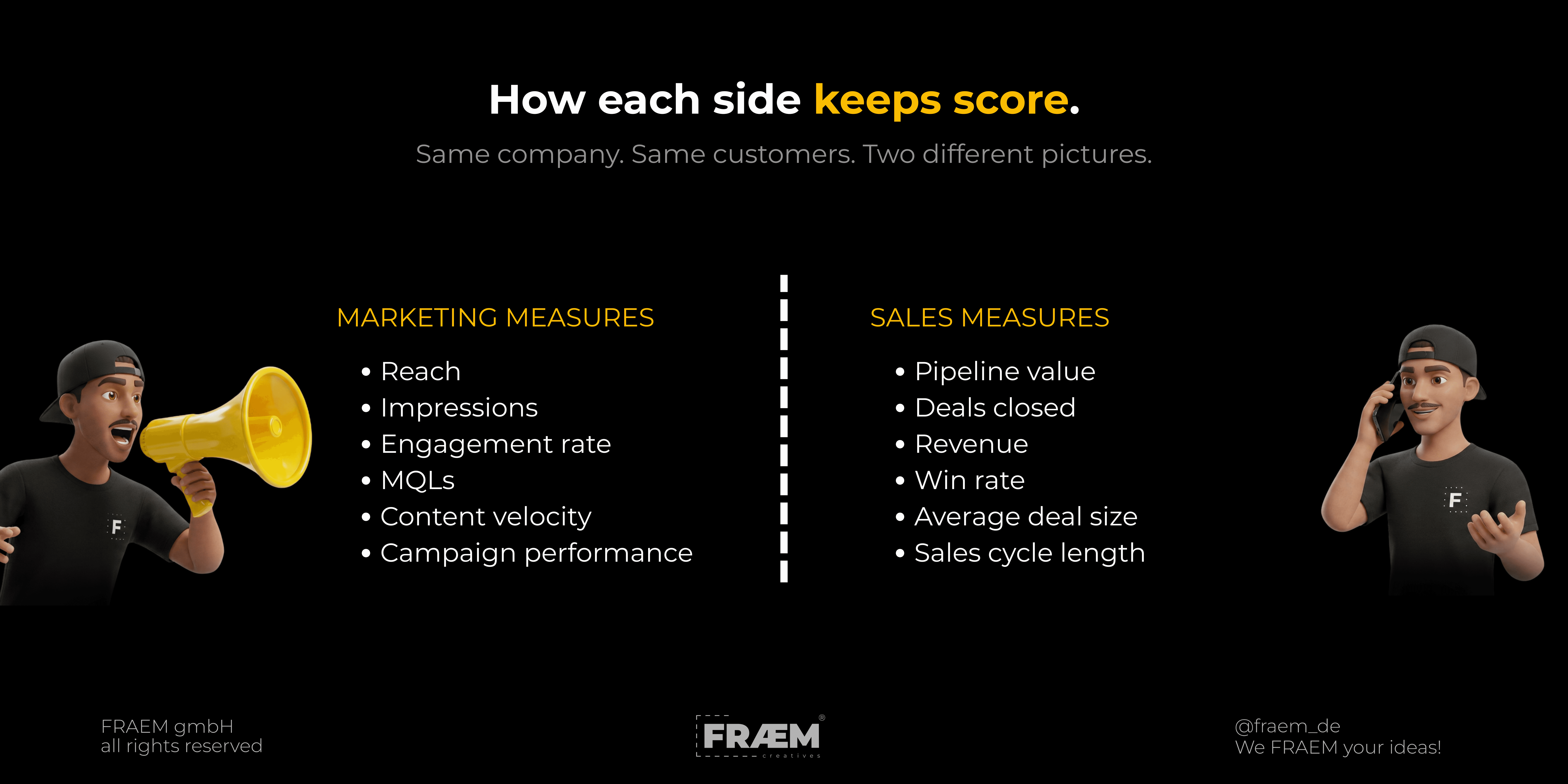
Most marketing teams are measured on outputs. Reach, impressions, MQLs, content velocity, campaign performance. The dashboards are designed to show what marketing produces.
Most sales teams are measured on outcomes. Pipeline value, deals closed, revenue, win rates, average deal size. The dashboards are designed to show what sales delivers.
Both sets of metrics make sense on their own. The problem is the gap between them. Marketing's outputs don't automatically convert into sales' outcomes, especially in sectors with long sales cycles, complex decision-making units, and high-value contracts. Which means you can have a quarter where marketing genuinely performed well and sales genuinely struggled, and both teams are correct about their own reality.
So you end up with two truths in the same room, and no shared language to reconcile them.
This is especially intense in our sector. In trades, construction, and industry, the path from "first touchpoint" to "signed contract" can be six months to two years. By the time a deal closes, nobody can clearly trace which campaign, content piece, or sales conversation actually moved the needle. Marketing claims the assist. Sales claims the close. The honest answer is usually that both contributed, but the data infrastructure to prove it doesn't exist.
That ambiguity is fertile ground for the disconnect to grow.
What the disconnect actually looks like (and how to spot it)
A few patterns we see over and over again:
Marketing is creating content sales doesn't use. The brochures, presentations, social posts, case studies, and email templates that marketing produces sit unused on a shared drive. Nobody on the sales team links to them in customer conversations. Nobody references them in proposals. They were built without sales input, and they don't reflect the questions sales actually gets in the field.
Sales is hearing things in the market that never make it back to marketing. The objections customers raise. The competitors they mention. The price comparisons they bring up. The features they ask about that the marketing materials don't address. All of this lives in sales' heads and gets repeated in CRM notes that nobody outside sales reads.
Marketing is targeting an audience sales doesn't recognize. The personas, the segments, the campaigns are all built around a customer profile that doesn't quite match the actual buyers sales is talking to. Maybe the marketing strategy assumes a decision-making committee, and the real decisions are made by one technical lead. Maybe the campaigns target a sector that's not really buying, while the sector that is buying gets ignored.
The "lead" definition is different on each side. Marketing's "qualified lead" might be a contact who downloaded a whitepaper. Sales' "qualified lead" is a contact with a budget, a timeline, and decision-making authority. Same word, completely different meaning.
If any of these patterns sound familiar, you're not dealing with a "marketing problem" or a "sales problem." You're dealing with an alignment problem. And alignment problems don't get solved by either team working harder in their own lane.
What marketing can actually do?
If you're on the marketing side of this conversation, here are four things that move the needle. None of them are about defending your dashboards.
Involve sales in the creation of corporate messaging
The people in your company who talk to prospects every single day know things you don't. They know when the lightbulb goes off in a sales conversation. They know what pushback comes up most often. They know what the word on the street is about your company, your competitors, and your category. If your messaging strategy gets built without that input, you're building it with one eye closed.
Grill your sales teams. Not in a confrontational way. In a "we need to know what you're hearing" way. Sit in on calls. Read CRM notes. Ask what customers actually say when they describe your product to a colleague. Then bake that into the messaging.
Translate corporate messaging into field-ready conversations
Marketing language and sales language are not the same. The last thing your sales team wants to walk into a meeting with is a deck full of "marketing speak." Phrases like "synergistic solutions" or "best-in-class platform" might survive a website headline. They will not survive a 60-minute conversation with a procurement lead who's already evaluating three competitors.
Translate high-level messaging into specific, concrete examples that work in the language of your target audience. And remember: what reads well in writing doesn't always sound good face-to-face, and vice versa. If sales can't actually say what marketing wrote, marketing needs to rewrite it.
Lead with insights
Marketing has something sales often doesn't: a macro perspective. You see the industry trends, the shifts in customer behavior, the competitive movements, the data patterns. Use that.
Look for insights that aren't already part of the current sales dialogue. Ways to challenge a prospect's thinking with something they haven't considered. Salespeople who walk into meetings with genuinely new perspectives, not just product pitches, build trust faster and close at higher rates. Help them do that.
Stop reporting only on what's easy to measure
This is the harder one. If your reporting only tracks impressions and clicks, you're reinforcing the disconnect. Marketing reports look great. Sales reports tell a different story. And neither team understands the other's reality.
Find ways to report on metrics that matter to sales too. Pipeline influenced. Content that gets used in actual sales conversations. Campaigns that produce leads sales actually closes. It's harder to measure, and the data is messier. But it changes the conversation in the room.
What sales can actually do?
If you're on the sales side, the disconnect isn't going to fix itself either. Here's what helps.
Speak up. Specifically.
If you never use the presentations, decks, one-pagers, or case studies that marketing creates, tell them. And tell them why. "It doesn't resonate with my customers" is a start. "My customers ask about pricing transparency in the first ten minutes and this deck doesn't address it until slide 23" is much more useful.
But don't stop at criticism. Tell marketing what you would use instead. What would actually help in the conversation you're having? What materials don't exist that should? What would make you grab a piece of content and send it to a prospect after a meeting? That's the level of specificity marketing can act on.
Be the ears of the company
You're in the room with customers and prospects more than anyone else in the business. Listen closely for which messages are resonating and which ones aren't. Which talking points cause heads to nod. Which ones cause people to glaze over. Which competitor names come up unprompted. Which objections appear in every third meeting.
Then circle back with marketing so the messages at the corporate level can stay aligned with what's actually landing in the field. This isn't reporting. It's intelligence-sharing. And it makes everyone's job easier.
Share the stories
You have a unique opportunity to capture real-life customer stories. The reason a contract closed. The moment the prospect's posture changed. The line that turned a skeptic into a buyer. The deal that almost fell apart and what saved it.
You don't have to write any of this down formally. Just phone it into marketing. They can turn it into case studies, social content, sales enablement assets, anything. Stories from the field are the most credible content a B2B company can produce. They're also the hardest to get because they're locked in sales' heads. Unlock them.
Recognize that not every customer comes from a referral
This one's controversial in some sales teams, but worth saying. If half your customers come from referrals or trade fairs, that's great. But it's not scalable on its own. At some point, the business needs a system that generates qualified opportunities outside the relationships you already have. That's what marketing exists for. Dismissing the entire function because referrals work today is short-sighted, especially in a sector where your best customers and best people are getting older and the next generation is harder to reach through traditional channels alone.
What it actually looks like when both sides align
When this works, it doesn't look dramatic. It looks like:
A weekly or monthly meeting where sales and marketing actually share what they're seeing in the market, not just present numbers.
Content that sales actively requests, uses, and forwards to prospects, instead of ignoring.
A shared definition of what makes a "qualified lead," agreed on by both sides, written down somewhere, and updated when things change.
Marketing campaigns that get tested on real customer conversations before they launch publicly.
Sales feedback loops that go beyond CRM notes nobody reads. Conversations. Slack channels. Voice memos. Whatever works for your team.
A reporting layer that connects marketing activity to sales outcomes, even if imperfectly. The goal isn't perfect attribution. It's a shared narrative about how the business actually wins customers.
The companies that get this right have a quiet superpower. Their marketing feels more grounded because it's informed by what's happening in real sales conversations. Their sales feels more strategic because they walk into meetings with insights, not just pitches. And the question of "who's right" stops coming up, because both sides are operating from the same picture.
What this means for you
If you're sitting in a company where sales and marketing disagree about whether the work is working, here's the practical takeaway.
The argument isn't usually about who's right. It's about the lack of a shared system that lets both sides be right at the same time. Marketing might be producing genuinely strong outputs. Sales might be genuinely struggling to close. Both can be true.
The fix is not picking a side. The fix is building the bridge between the two functions. Shared definitions. Shared rhythms. Shared customer intelligence. Shared metrics that connect marketing activity to sales outcomes.
This is also where we see the most pushback when we work with companies. Because alignment work feels less exciting than launching campaigns or closing deals. It feels like internal admin. And it gets pushed to "next quarter" every quarter.
But the companies that invest in alignment stop having the argument. They stop wasting time defending their dashboards to each other. They start operating like one team that happens to have two functions, instead of two teams that happen to share a logo.
That's the real shift.
One more thing. (imagine Steve Jobs saying this)
We don't say this to claim we have a magic process for fixing sales-marketing alignment. We don't. Nobody does. The work is ongoing and the answers change as the business changes.
What we do believe is that the question "who's right" is almost always the wrong question. The interesting work happens when both sides stop trying to win the argument and start trying to understand why the disconnect exists.
If your sales and marketing teams are stuck in this loop, and you want a partner who can help you build a communication system that both sides actually use, let's talk.
Frequently Asked Questions!
Why does the sales vs. marketing tension exist in almost every company?
Because both functions are measured on different metrics, optimize for different timelines, and often have separate data systems. Marketing focuses on top-of-funnel outputs, sales focuses on bottom-of-funnel outcomes, and the connection between the two is rarely instrumented well enough to give either side a complete picture. Add long sales cycles and complex decision-making (common in trades, construction, and industry), and the gap widens further.

AI Search Is Here. SEO Isn't Dead. Here's What Matters.
43% of Germans use ChatGPT. Search is quietly changing under everyone's feet. Here's what's real, what's hype, and what your business should actually do about it.

Why Your Handwerk Website Isn't Doing Its Job
94% of German Handwerk businesses have a website. Only 3 of 500 audited sites came close to actually doing their job. Here's what "it works for us" is really costing you.

Framer vs. WordPress vs. TYPO3
Framer or WordPress for your Handwerk business? An honest comparison on cost, maintenance, and SEO. Plus when Webflow or TYPO3 actually makes sense.