Phase 04 - Evolve
Phase 04 - Evolve
SEO & AI Visibility:
SEO & AI Visibility:
Named, not just found.
Named, not just found.
Searching increasingly ends without a click. We work on getting you into both surfaces: high in the results and inside the answer an AI writes from them. Same groundwork, two outcomes.
Searching increasingly ends without a click. We work on getting you into both surfaces: high in the results and inside the answer an AI writes from them. Same groundwork, two outcomes.
Definition line
SEO is the work of appearing in search results without paying for the place. There is now a second surface alongside it: answers an AI writes, choosing its own sources as it goes. Same groundwork, a different result list, and one of the two has no list at all.
SEO is the work of appearing in search results without paying for the place. There is now a second surface alongside it: answers an AI writes, choosing its own sources as it goes. Same groundwork, a different result list, and one of the two has no list at all.
SEO is the work of appearing in search results without paying for the place. There is now a second surface alongside it: answers an AI writes, choosing its own sources as it goes. Same groundwork, a different result list, and one of the two has no list at all.
Scope
What is included


Problem List
This is for you if
You rank on page one, and the enquiries still do not come.
Above the first organic result there is now often an answer that has already answered the question.
ChatGPT recommends your competitors and not you.
Whoever asks there gets three names. If yours is not among them, the shortlist happens without you.
Your texts are good, and nobody quotes them.
Anything with no number, no source and no sentence that stands on its own is hard to quote, however well it is written.
Nobody knows which of your pages Google even has.
Indexing gets checked once something is missing, and by then it has usually been missing for longer than a quarter.
What changes and what does not
What changes and what does not
Three answers to whether everything is different now.
Three answers to whether everything is different now.
Since AI answers appeared in search results, a lot gets sold as new that is not. Most of the work stays the same, some of it is added, and a few things demonstrably do nothing. We sort that out once at the start of every project.
Since AI answers appeared in search results, a lot gets sold as new that is not. Most of the work stays the same, some of it is added, and a few things demonstrably do nothing. We sort that out once at the start of every project.
1
Stays.
Being indexable, writing clearly, answering the question. Google states outright that there are no additional requirements for AI answers. If the basics are missing, you do not appear there either.
1
Stays.
Being indexable, writing clearly, answering the question. Google states outright that there are no additional requirements for AI answers. If the basics are missing, you do not appear there either.
2
Gets added.
Becoming quotable. In the study that coined the term GEO, built-in quotations, cited statistics and named sources produced the largest gains in visibility. Not more text, text that can be backed up.
2
Gets added.
Analysis, concept, production or evaluation, depending on the phase. Whatever comes out, we sort it before you see it. Not every inconsistency is a problem, and not every finding matters equally. You get what counts, not all of it. We need nothing from you.
3
Does nothing.
An llms.txt, keyword density, and files supposedly made for AI. In the same research setup keyword stuffing scored below the baseline, and Google says no additional markup is needed.
3
Does nothing.
Whether it is a workshop, feedback round or review call depends on the phase. Who decides does not. What we have is on the table, the options get tested, and the direction is set by those who will defend it internally.
„To appear in an AI answer you have to say something that can be quoted. That is not a technical problem."
„To appear in an AI answer you have to say something that can be quoted. That is not a technical problem."
„To appear in an AI answer you have to say something that can be quoted. That is not a technical problem."







Frequently Asked
Frequently Asked
Questions
Questions
What is the difference between SEO and AI visibility?
The surface, not the work. SEO gets your page found, AI visibility gets it named inside a written answer. The groundwork is the same, which is why both sit on one page.
Google says so itself: there are no additional requirements and no separate optimisation for AI Overviews or AI Mode. If you are indexed, write clearly and actually answer the question, you can appear there. It is still not the same thing. In a result list the winner is whoever sits at the top, in an answer it is whoever can be quoted. That moves the work from position to phrasing: a sentence that stands on its own, a number that is backed up, a source that is named. The same principle applies to systems like ChatGPT, only without public documentation. So we treat it as one service with two outcomes, not two products you pay for twice.
Framer is a web builder for creative pros. Be sure to check out framer.com to learn more.
The surface, not the work. SEO gets your page found, AI visibility gets it named inside a written answer. The groundwork is the same, which is why both sit on one page.
Google says so itself: there are no additional requirements and no separate optimisation for AI Overviews or AI Mode. If you are indexed, write clearly and actually answer the question, you can appear there. It is still not the same thing. In a result list the winner is whoever sits at the top, in an answer it is whoever can be quoted. That moves the work from position to phrasing: a sentence that stands on its own, a number that is backed up, a source that is named. The same principle applies to systems like ChatGPT, only without public documentation. So we treat it as one service with two outcomes, not two products you pay for twice.
How long until we see something?
Technical fixes land in weeks, content in months. We expect the first movements you can rely on after three to six months, and anyone telling you otherwise is selling an expectation, not a service.
The reason is unglamorous: a page has to be crawled again, assessed and compared with others, and that does not happen on request. It is only faster where something was broken. A page that was accidentally not indexed shows up within days of the fix, and that is regularly the first visible win. After that it gets slower and, in exchange, steadier.
What matters is what you measure in the meantime: not visitor numbers, but whether the right pages appear for the right questions. If you need revenue in three months, it will not come from here, it comes from paid campaigns. Running both at once is the most common and the most sensible case.
Framer is a web builder for creative pros. Be sure to check out framer.com to learn more.
Technical fixes land in weeks, content in months. We expect the first movements you can rely on after three to six months, and anyone telling you otherwise is selling an expectation, not a service.
The reason is unglamorous: a page has to be crawled again, assessed and compared with others, and that does not happen on request. It is only faster where something was broken. A page that was accidentally not indexed shows up within days of the fix, and that is regularly the first visible win. After that it gets slower and, in exchange, steadier.
What matters is what you measure in the meantime: not visitor numbers, but whether the right pages appear for the right questions. If you need revenue in three months, it will not come from here, it comes from paid campaigns. Running both at once is the most common and the most sensible case.
Are AI answers taking our visitors away?
Partly, and not everywhere equally. In Germany an AI summary appears on roughly one search in five. It mainly affects explanatory questions, and rarely brand, local or buying queries.
The best known study comes from the Pew Research Center: across around 900 people and almost 70,000 searches, a result was clicked in 15 percent of cases, and in only 8 percent when an AI summary was present. Around one percent clicked a source inside the summary.
Google disputes the methodology, which is worth saying out loud. For the German market an analysis of more than 100 million search terms puts the share at about 20 percent, rising to around 30 for very specific questions. What matters is which questions those are: explanatory and comparative ones. AI summaries are rare for brand, local and buying queries, which is exactly where enquiries come from in mid-sized companies. So the right response is not panic but a shift: fewer pages that explain things in general, more pages only you can answer.
Framer is a web builder for creative pros. Be sure to check out framer.com to learn more.
Partly, and not everywhere equally. In Germany an AI summary appears on roughly one search in five. It mainly affects explanatory questions, and rarely brand, local or buying queries.
The best known study comes from the Pew Research Center: across around 900 people and almost 70,000 searches, a result was clicked in 15 percent of cases, and in only 8 percent when an AI summary was present. Around one percent clicked a source inside the summary.
Google disputes the methodology, which is worth saying out loud. For the German market an analysis of more than 100 million search terms puts the share at about 20 percent, rising to around 30 for very specific questions. What matters is which questions those are: explanatory and comparative ones. AI summaries are rare for brand, local and buying queries, which is exactly where enquiries come from in mid-sized companies. So the right response is not panic but a shift: fewer pages that explain things in general, more pages only you can answer.
How do you get into an AI answer at all?
By writing so you can be quoted. In the study that coined the term GEO, built-in quotations, statistics and named sources produced the largest gains, while keyword stuffing scored below the baseline.
The study tested nine methods across ten thousand search queries. The largest visibility gains were around 40 percent, achieved by adding quotations, closely followed by cited statistics and named sources. Plain language helped too. Higher keyword density did worse than doing nothing at all. The part that matters most for you: the further down a page sat in the classic results, the more the rework gained, while the page already in first place lost ground. This is the first mechanism in years where smaller providers have a structural advantage. We work to that, not to whatever a tool vendor is currently selling as a secret.
Framer is a web builder for creative pros. Be sure to check out framer.com to learn more.
By writing so you can be quoted. In the study that coined the term GEO, built-in quotations, statistics and named sources produced the largest gains, while keyword stuffing scored below the baseline.
The study tested nine methods across ten thousand search queries. The largest visibility gains were around 40 percent, achieved by adding quotations, closely followed by cited statistics and named sources. Plain language helped too. Higher keyword density did worse than doing nothing at all. The part that matters most for you: the further down a page sat in the classic results, the more the rework gained, while the page already in first place lost ground. This is the first mechanism in years where smaller providers have a structural advantage. We work to that, not to whatever a tool vendor is currently selling as a secret.
Want to learn more about us? Check out our entire FAQ!
Want to learn more about us? Check out our entire FAQ!
Interested in Content Marketing?
Check out our most recent articles!
Interested in Content Marketing?
Check out our most recent articles!

How Handwerk Businesses Actually Find Azubis: 5 Steps
Finding Azubis and skilled workers in Handwerk: why job ads alone don't work and which five steps actually bring applications.
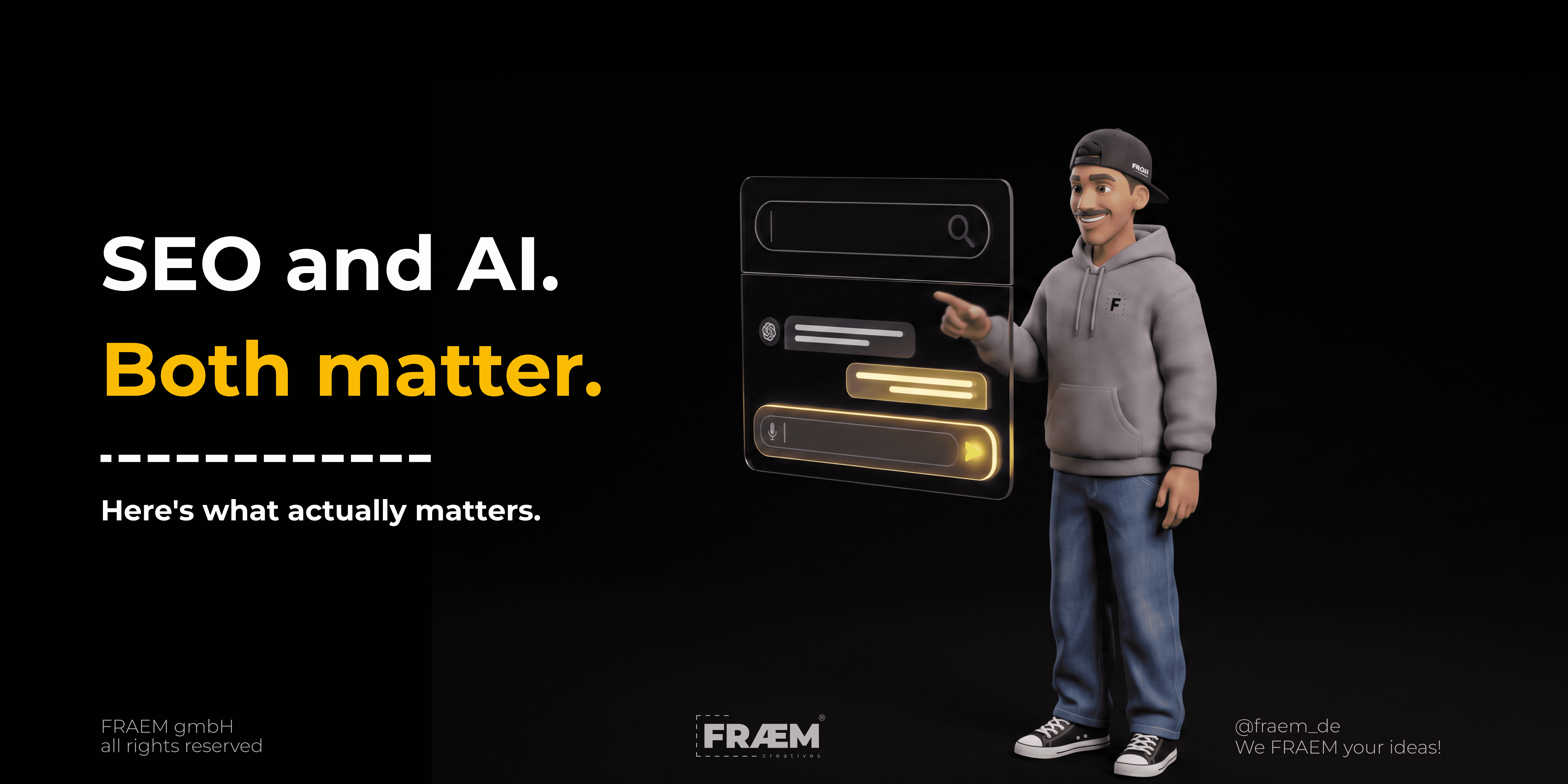
AI Search Is Here. SEO Isn't Dead. Here's What Matters.
43% of Germans use ChatGPT. Search is quietly changing under everyone's feet. Here's what's real, what's hype, and what your business should actually do about it.

Sales vs. Marketing: Who's Actually Right?
The classic sales vs. marketing argument is rarely about who's right. It's usually about a disconnect nobody wants to name. Here's how to spot it, and how to fix it.

Marketing in Trades and Construction, Done Right
Trades, construction and industry don't work like other sectors. Here's what we've learned from years of doing marketing in this space, with examples from the work.
How Handwerk Businesses Actually Find Azubis: 5 Steps
Finding Azubis and skilled workers in Handwerk: why job ads alone don't work and which five steps actually bring applications.
AI Search Is Here. SEO Isn't Dead. Here's What Matters.
43% of Germans use ChatGPT. Search is quietly changing under everyone's feet. Here's what's real, what's hype, and what your business should actually do about it.
Sales vs. Marketing: Who's Actually Right?
The classic sales vs. marketing argument is rarely about who's right. It's usually about a disconnect nobody wants to name. Here's how to spot it, and how to fix it.
How Handwerk Businesses Actually Find Azubis: 5 Steps
Finding Azubis and skilled workers in Handwerk: why job ads alone don't work and which five steps actually bring applications.
AI Search Is Here. SEO Isn't Dead. Here's What Matters.
43% of Germans use ChatGPT. Search is quietly changing under everyone's feet. Here's what's real, what's hype, and what your business should actually do about it.

Why Your Handwerk Website Isn't Doing Its Job
94% of German Handwerk businesses have a website. Only 3 of 500 audited sites came close to actually doing their job. Here's what "it works for us" is really costing you.

Framer vs. WordPress vs. TYPO3
Framer or WordPress for your Handwerk business? An honest comparison on cost, maintenance, and SEO. Plus when Webflow or TYPO3 actually makes sense.
Content that converts
(and doesn’t suck).
Let’s talk.
Content that converts
(and doesn’t suck).
Let’s talk.
Content that converts
(and doesn’t suck).
Let’s talk.


Nikkan & Soli Managing Directors
Nikkan & Soli Managing Directors
Nikkan & Soli Managing Directors