Phase 04 - Evolve
Phase 04 - Evolve
Strategy Sparring:
Strategy Sparring:
Someone who pushes back.
Someone who pushes back.
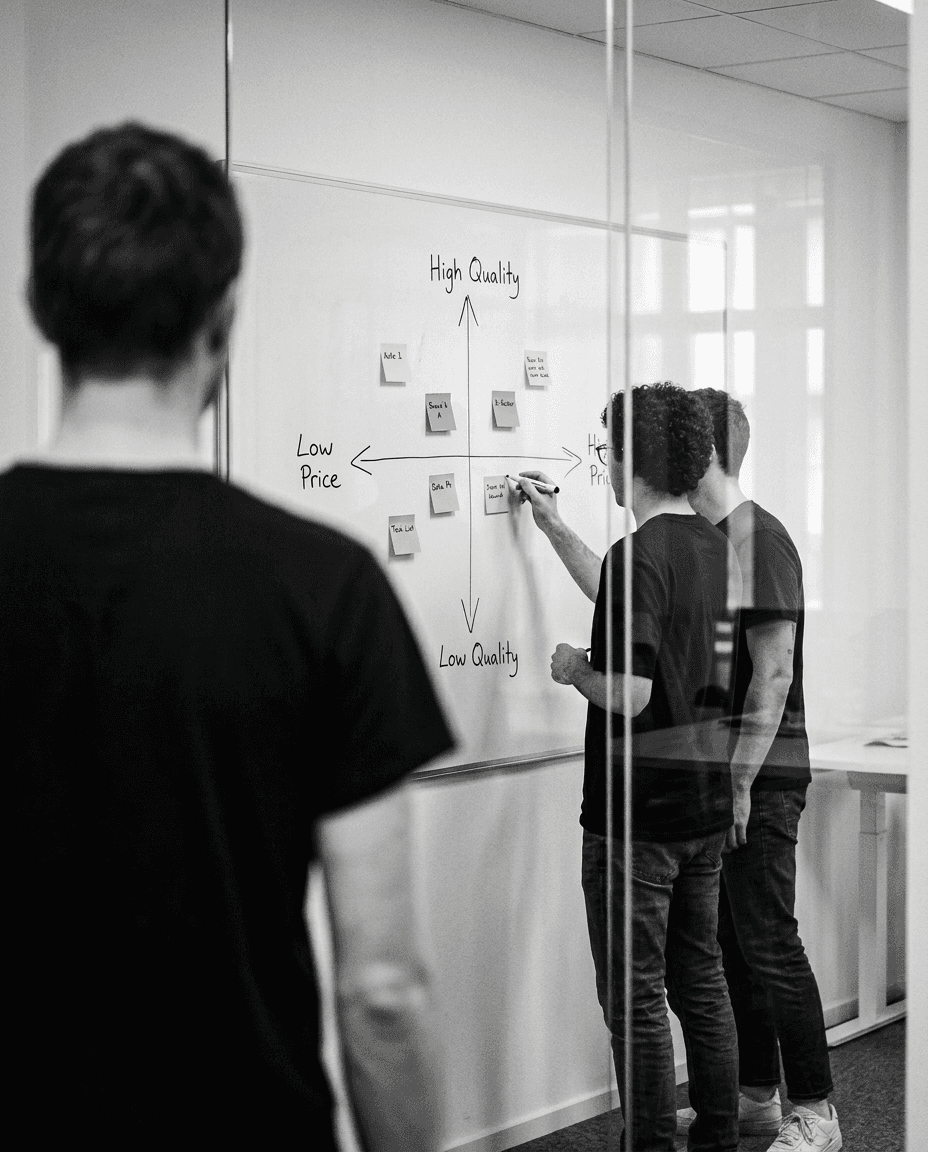
You have prepared a decision and nobody to seriously attack it. We sit down, look for the parts that do not hold, and say at the end what we would do in your position. Even when that means doing nothing.
You have prepared a decision and nobody to seriously attack it. We sit down, look for the parts that do not hold, and say at the end what we would do in your position. Even when that means doing nothing.
Definition line
Strategy sparring is the structured testing of a decision you have already made or prepared, by someone from outside. It does not produce a strategy, it puts pressure on the one you have. If you have nothing to test yet, you need a different service first.
Strategy sparring is the structured testing of a decision you have already made or prepared, by someone from outside. It does not produce a strategy, it puts pressure on the one you have. If you have nothing to test yet, you need a different service first.
Strategy sparring is the structured testing of a decision you have already made or prepared, by someone from outside. It does not produce a strategy, it puts pressure on the one you have. If you have nothing to test yet, you need a different service first.
Scope
What is included


Problem List
This is for you if
Everyone nods in the meeting, then everyone does something else.
Agreement in the room is not consent, often it only means nobody wants to be the one holding things up.
Your positioning came from you, which is why you believe it.
From the inside there is no way to judge whether a difference you can see is a difference to a customer.
A new market looks good, and the decision gets made on instinct.
Entering a market ties up a year of attention, and the reasons against it usually surface in the second one.
Your agency says yes to everything.
Anyone who earns from the execution rarely has an interest in questioning the decision beforehand.
What we do
- Read what you have beforehand.
- Push back, check the arithmetic and put it in context in the session.
- Afterwards, write down the points that need a decision. No research, no concept, no slide deck.
What you do
- Send what exists beforehand, unfinished is fine.
- Bring the person who is allowed to decide.
- Expect one of your assumptions not to hold.
- Nothing else.
„Buy agreement and you pay twice. Once for the advice and once for the correction."
„Buy agreement and you pay twice. Once for the advice and once for the correction."
„Buy agreement and you pay twice. Once for the advice and once for the correction."






Frequently Asked
Frequently Asked
Questions
Questions
How is this different from brand strategy or positioning?
Those produce something, this tests something. A sparring is a second opinion on what you already have, not a replacement for the work that comes before it. If you have nothing yet, you hear that first.
The comparison with medicine fits. A second opinion does not replace a diagnosis, it checks an existing one, and it is faster and cheaper than the first time round. Same here: brand and positioning produces the sentence you decide by, brand strategy the longer plan behind it, and the audience and market analysis gathers the data both rest on.
The sparring sits down with all of that and looks for the parts that do not hold. If it turns out in the session that the basis is missing, we say so rather than carrying on as though it were there. Both together is the normal case, one after the other and not instead of each other. Anyone who books a sparring with nothing to test gets a recommendation from us and not an invoice.
Framer is a web builder for creative pros. Be sure to check out framer.com to learn more.
Those produce something, this tests something. A sparring is a second opinion on what you already have, not a replacement for the work that comes before it. If you have nothing yet, you hear that first.
The comparison with medicine fits. A second opinion does not replace a diagnosis, it checks an existing one, and it is faster and cheaper than the first time round. Same here: brand and positioning produces the sentence you decide by, brand strategy the longer plan behind it, and the audience and market analysis gathers the data both rest on.
The sparring sits down with all of that and looks for the parts that do not hold. If it turns out in the session that the basis is missing, we say so rather than carrying on as though it were there. Both together is the normal case, one after the other and not instead of each other. Anyone who books a sparring with nothing to test gets a recommendation from us and not an invoice.
What do we have in hand at the end?
A short written summary, two or three pages: what was tested, what does not hold, what we would do in your position, and which decision comes next. Not a presentation, not even on request.
That sounds like little, and it is deliberate. A slide deck would make the session look more important and dilute what it says, because across forty pages everyone picks the slide that suits them. Two or three pages cannot be explained to anybody who has not read them. What happens in the session matters more than the paper anyway: most of the insight appears while someone from your side has to defend their own plan out loud.
Afterwards we write down what stopped holding up. If you need a document out of it for a board or a bank, that is a separate job and we say so up front. It does not work with no paper at all, though, because what nobody writes down gets remembered differently.
Framer is a web builder for creative pros. Be sure to check out framer.com to learn more.
A short written summary, two or three pages: what was tested, what does not hold, what we would do in your position, and which decision comes next. Not a presentation, not even on request.
That sounds like little, and it is deliberate. A slide deck would make the session look more important and dilute what it says, because across forty pages everyone picks the slide that suits them. Two or three pages cannot be explained to anybody who has not read them. What happens in the session matters more than the paper anyway: most of the insight appears while someone from your side has to defend their own plan out loud.
Afterwards we write down what stopped holding up. If you need a document out of it for a board or a bank, that is a separate job and we say so up front. It does not work with no paper at all, though, because what nobody writes down gets remembered differently.
Do you not just end up recommending your own services?
The risk is real and we do not claim to be neutral. That is why a sparring is commissioned separately, paid for separately, and never offset against a follow-up project. A creditable fee would be a deposit on the execution.
An agency whose strategy fee gets credited against the follow-up job has an interest in the follow-up job. That is the usual arrangement and it gets sold as a favour. We do not do it, because a creditable fee is economically a deposit on the execution. With us the sparring stays its own service at its own price, whether or not a large project follows.
Second, we say in the session when we are not the right people for something, for instance sales structure, pricing, or anything a management consultancy should handle. You can test this with one question: ask in the first conversation which recommendation we last handed to somebody else. If you do not get an answer, you have your answer.
Framer is a web builder for creative pros. Be sure to check out framer.com to learn more.
The risk is real and we do not claim to be neutral. That is why a sparring is commissioned separately, paid for separately, and never offset against a follow-up project. A creditable fee would be a deposit on the execution.
An agency whose strategy fee gets credited against the follow-up job has an interest in the follow-up job. That is the usual arrangement and it gets sold as a favour. We do not do it, because a creditable fee is economically a deposit on the execution. With us the sparring stays its own service at its own price, whether or not a large project follows.
Second, we say in the session when we are not the right people for something, for instance sales structure, pricing, or anything a management consultancy should handle. You can test this with one question: ask in the first conversation which recommendation we last handed to somebody else. If you do not get an answer, you have your answer.
How does a session run, and who is in the room?
One session of two to three hours, two people from our side, at most four from yours, including whoever is allowed to decide. We read what you have beforehand. From five people on it turns into a presentation.
The upper limit matters more than the lower one. From about five people from one company onwards a sparring turns into a presentation, because nobody admits in front of half a department that an assumption is shaky. Four is the point where we ask who is really needed. Two come from our side, because one person alone slips too easily into agreeing.
The run of it is unglamorous: you present your plan, we ask questions, and for longer than is comfortable. We stay on the places where an assumption is not backed up. There is a second session only when a question comes up that somebody has to go and check internally first. That one is short and costs nothing extra.
Framer is a web builder for creative pros. Be sure to check out framer.com to learn more.
One session of two to three hours, two people from our side, at most four from yours, including whoever is allowed to decide. We read what you have beforehand. From five people on it turns into a presentation.
The upper limit matters more than the lower one. From about five people from one company onwards a sparring turns into a presentation, because nobody admits in front of half a department that an assumption is shaky. Four is the point where we ask who is really needed. Two come from our side, because one person alone slips too easily into agreeing.
The run of it is unglamorous: you present your plan, we ask questions, and for longer than is comfortable. We stay on the places where an assumption is not backed up. There is a second session only when a question comes up that somebody has to go and check internally first. That one is short and costs nothing extra.
Want to learn more about us? Check out our entire FAQ!
Want to learn more about us? Check out our entire FAQ!
Interested in Content Marketing?
Check out our most recent articles!
Interested in Content Marketing?
Check out our most recent articles!

How Handwerk Businesses Actually Find Azubis: 5 Steps
Finding Azubis and skilled workers in Handwerk: why job ads alone don't work and which five steps actually bring applications.
AI Search Is Here. SEO Isn't Dead. Here's What Matters.
43% of Germans use ChatGPT. Search is quietly changing under everyone's feet. Here's what's real, what's hype, and what your business should actually do about it.

Sales vs. Marketing: Who's Actually Right?
The classic sales vs. marketing argument is rarely about who's right. It's usually about a disconnect nobody wants to name. Here's how to spot it, and how to fix it.

Marketing in Trades and Construction, Done Right
Trades, construction and industry don't work like other sectors. Here's what we've learned from years of doing marketing in this space, with examples from the work.
How Handwerk Businesses Actually Find Azubis: 5 Steps
Finding Azubis and skilled workers in Handwerk: why job ads alone don't work and which five steps actually bring applications.
AI Search Is Here. SEO Isn't Dead. Here's What Matters.
43% of Germans use ChatGPT. Search is quietly changing under everyone's feet. Here's what's real, what's hype, and what your business should actually do about it.
Sales vs. Marketing: Who's Actually Right?
The classic sales vs. marketing argument is rarely about who's right. It's usually about a disconnect nobody wants to name. Here's how to spot it, and how to fix it.
How Handwerk Businesses Actually Find Azubis: 5 Steps
Finding Azubis and skilled workers in Handwerk: why job ads alone don't work and which five steps actually bring applications.
AI Search Is Here. SEO Isn't Dead. Here's What Matters.
43% of Germans use ChatGPT. Search is quietly changing under everyone's feet. Here's what's real, what's hype, and what your business should actually do about it.

Why Your Handwerk Website Isn't Doing Its Job
94% of German Handwerk businesses have a website. Only 3 of 500 audited sites came close to actually doing their job. Here's what "it works for us" is really costing you.

Framer vs. WordPress vs. TYPO3
Framer or WordPress for your Handwerk business? An honest comparison on cost, maintenance, and SEO. Plus when Webflow or TYPO3 actually makes sense.
Content that converts
(and doesn’t suck).
Let’s talk.
Content that converts
(and doesn’t suck).
Let’s talk.
Content that converts
(and doesn’t suck).
Let’s talk.


Nikkan & Soli Managing Directors
Nikkan & Soli Managing Directors
Nikkan & Soli Managing Directors