Phase 03 - Create
Phase 03 - Create
Content Production:
Content Production:
Shoot once, post for months.
Shoot once, post for months.
We produce across the full range: photo, video, motion, copy. Every piece is made for the platform and the audience it is meant for, not repurposed from somewhere else. One brief, one standard, every format.
We produce across the full range: photo, video, motion, copy. Every piece is made for the platform and the audience it is meant for, not repurposed from somewhere else. One brief, one standard, every format.
Definition line
Content production is the making of the material a brand appears with in its channels: photo, video, motion and social formats. It answers the question of what gets shown, not the question of when and where it goes out.
Content production is the making of the material a brand appears with in its channels: photo, video, motion and social formats. It answers the question of what gets shown, not the question of when and where it goes out.
Content production is the making of the material a brand appears with in its channels: photo, video, motion and social formats. It answers the question of what gets shown, not the question of when and where it goes out.
Scope
What is included


Our Content Production Models
Our Content Production Models
Clear structures. No guesswork.
Effective content marketing needs more than single services. That’s why FRAEM works with three clear collaboration models, depending on how much responsibility you want to hand over.
Full-service content marketing.
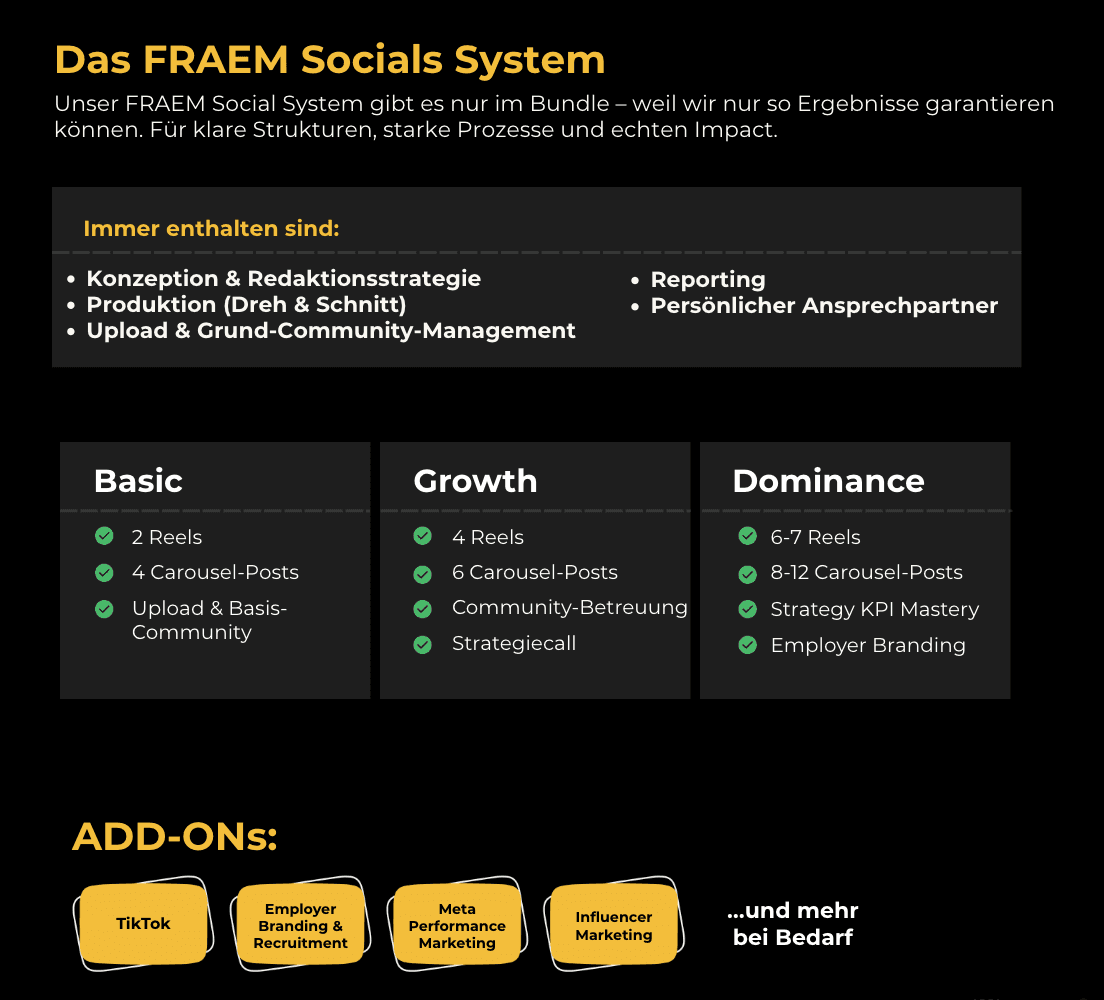
The FRAEM Socials System
Full-service content marketing.
The FRAEM Socials System
Full-service content marketing.
The FRAEM Socials System
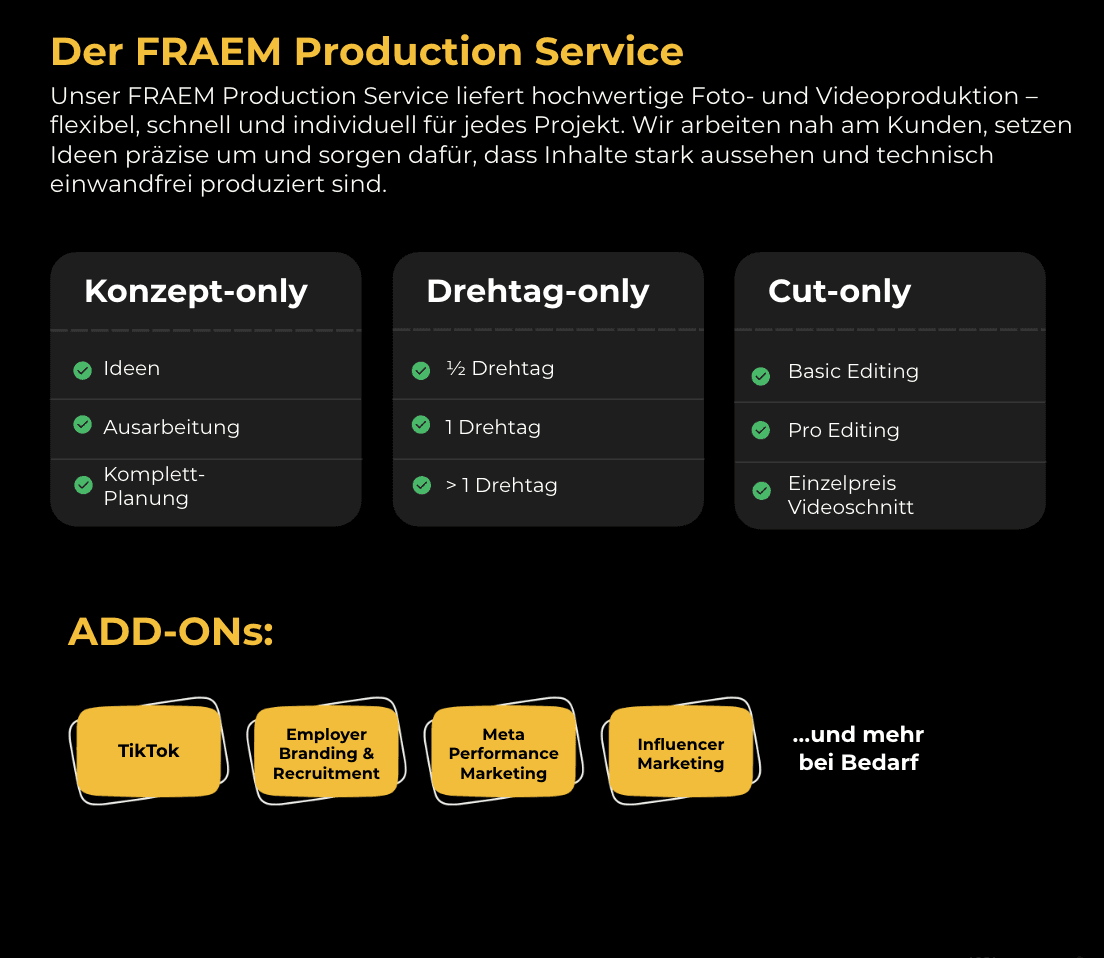
Execution only.
FRAEM Production Service
Execution only.
FRAEM Production Service
Execution only.
FRAEM Production Service
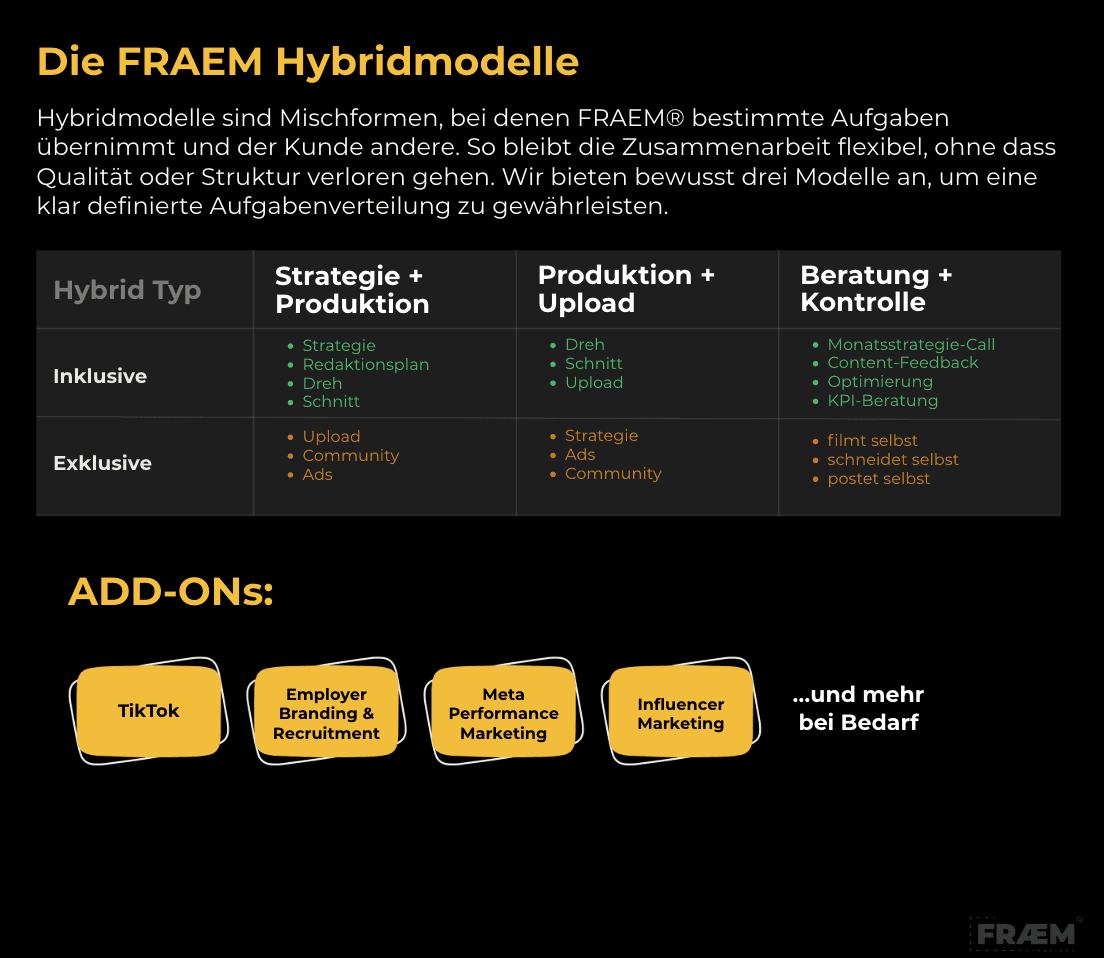
Shared responsibility.
FRAEM Hybrid Models
Shared responsibility.
FRAEM Hybrid Models
Shared responsibility.
FRAEM Hybrid Models
Problem List
This is for you if
The channel exists, the material does not.
The same discussion every week about what you could post, and in the end another stock photo goes out.
You shoot once a year, then it goes quiet.
One big film, twelve months of silence. Channels live on supply, not on a single high point.
The content looks like four different companies.
Every shoot had a different crew and a different idea. Together that is not a brand, it is a collection.
AI is tempting, but nobody knows what is allowed.
The AI Act transparency rules have applied since August, and nobody in the building wants to be the one who gets it wrong.
The channel exists, the material does not.
The same discussion every week about what you could post, and in the end another stock photo goes out.
You shoot once a year, then it goes quiet.
One big film, twelve months of silence. Channels live on supply, not on a single high point.
The content looks like four different companies.
Every shoot had a different crew and a different idea. Together that is not a brand, it is a collection.
AI is tempting, but nobody knows what is allowed.
The AI Act transparency rules have applied since August, and nobody in the building wants to be the one who gets it wrong.
Reference

What that looked like at AL-KO.
What that looked like at AL-KO.
Keep two brands visible in three markets without making them sound the same.
Keep two brands visible in three markets without making them sound the same.
Instead of shooting one campaign and distributing it, we produce continuously: topic planning by season, Instagram and TikTok made for the platform rather than cropped for it, two separate visual worlds for AL-KO and solo®. Splitting the brands was our recommendation. What works organically then gets paid support.
Instead of shooting one campaign and distributing it, we produce continuously: topic planning by season, Instagram and TikTok made for the platform rather than cropped for it, two separate visual worlds for AL-KO and solo®. Splitting the brands was our recommendation. What works organically then gets paid support.
Social-first Content Production
Video and photo production
Motion Design & Animation




Content Creation in Action
Content Creation in Action
Content Creation in Action
A glimpse at the companies we have supported with content creation.
A glimpse at the companies we have supported with content creation.
A glimpse at the companies we have supported with content creation.
„Most companies do not have a content problem, they have a supply problem. One film a year helps nobody for the other eleven months."
„Most companies do not have a content problem, they have a supply problem. One film a year helps nobody for the other eleven months."
„Most companies do not have a content problem, they have a supply problem. One film a year helps nobody for the other eleven months."


How one day becomes a supply
How one day becomes a supply
Why content is not bought by the piece.
Why content is not bought by the piece.
A single post costs almost as much as ten, because the effort sits in getting there, setting up and deciding, not in pressing the button. So we plan in shoot days, not in posts.
A single post costs almost as much as ten, because the effort sits in getting there, setting up and deciding, not in pressing the button. So we plan in shoot days, not in posts.
1
Planning
A list becomes the volume.
Before the shoot it is settled which formats are needed and what for. That list decides whether there is material at the end of the day or just nice footage. It is the part that costs nothing and determines everything.
1
Planning
A list becomes the volume.
Before the shoot it is settled which formats are needed and what for. That list decides whether there is material at the end of the day or just nice footage. It is the part that costs nothing and determines everything.
2
Shoot
One situation becomes several angles.
The same scene is shot once calm and wide for the website and once close and vertical for the channels. On the day that costs minutes. Afterwards it costs a second shoot day.
2
Shoot
One situation becomes several angles.
Analysis, concept, production or evaluation, depending on the phase. Whatever comes out, we sort it before you see it. Not every inconsistency is a problem, and not every finding matters equally. You get what counts, not all of it. We need nothing from you.
3
Edit
One set of material becomes months.
The edit does not happen once, it happens in waves: first whatever has the nearest deadline, the rest spread across the season. Individual pieces run again later as ads.
3
Edit
One set of material becomes months.
Whether it is a workshop, feedback round or review call depends on the phase. Who decides does not. What we have is on the table, the options get tested, and the direction is set by those who will defend it internally.
Our creative stack!
Behind every scroll-stopping story is a toolkit made for creators. We use powerful platforms to ideate, write, design, and publish content that connects.


Frequently Asked
Frequently Asked
Questions
Questions
What is content production, and how is it different from social media management?
Content production makes the material: photos, videos, motion, social formats. Social media management then decides what goes out when and where, and runs the channels. Production is a project, management is ongoing.
The distinction sounds academic, but it decides what you should ask for. If you want to publish something every two weeks and you know what, you need supply, so production. If you have nobody to look after it, you need someone to run the channels, and that is an Evolve service. Most enquiries are really both. Then it pays to start with production, because a content calendar without material is a list of intentions. T
he other way round works: a stock of material helps even if you run the channels yourselves. We say in the first call which of the two you actually need, even when that is the smaller number. A workable test: if your sentence starts with „we have nothing to show", it is production. If it starts with „nobody is looking after it", it is management.
Framer is a web builder for creative pros. Be sure to check out framer.com to learn more.
Content production makes the material: photos, videos, motion, social formats. Social media management then decides what goes out when and where, and runs the channels. Production is a project, management is ongoing.
The distinction sounds academic, but it decides what you should ask for. If you want to publish something every two weeks and you know what, you need supply, so production. If you have nobody to look after it, you need someone to run the channels, and that is an Evolve service. Most enquiries are really both. Then it pays to start with production, because a content calendar without material is a list of intentions. T
he other way round works: a stock of material helps even if you run the channels yourselves. We say in the first call which of the two you actually need, even when that is the smaller number. A workable test: if your sentence starts with „we have nothing to show", it is production. If it starts with „nobody is looking after it", it is management.
Why not just shoot one film and cut it down for social?
Because a film for the website needs different footage than a clip for Instagram. Landscape, a slow opening, music instead of speech. Cropping fixes the format, not the effect.
Platforms do not punish anything, they only reward what fits, and what fits is very concrete: vertical, because nobody turns the phone. Subtitles, because the sound is off. One point in the first three seconds, because after that people swipe. A brand film is built on the opposite, on build-up and atmosphere. So we plan the shoot day for several targets from the start: the same situation once calm and wide for the website, once close and vertical for the channels. That costs little extra time on the day and saves the second shoot that would otherwise be needed three months later, when someone notices none of it works on a phone.
Framer is a web builder for creative pros. Be sure to check out framer.com to learn more.
Because a film for the website needs different footage than a clip for Instagram. Landscape, a slow opening, music instead of speech. Cropping fixes the format, not the effect.
Platforms do not punish anything, they only reward what fits, and what fits is very concrete: vertical, because nobody turns the phone. Subtitles, because the sound is off. One point in the first three seconds, because after that people swipe. A brand film is built on the opposite, on build-up and atmosphere. So we plan the shoot day for several targets from the start: the same situation once calm and wide for the website, once close and vertical for the channels. That costs little extra time on the day and saves the second shoot that would otherwise be needed three months later, when someone notices none of it works on a phone.
Do you shoot yourselves, and what happens on a shoot day?
We shoot with a small, regular crew. A shoot day means preparation with you, four to six hours on site, then the edit. It is planned so that several formats come out of it.
Before the shoot there is a list: which situations, which people, which rooms, and which of them is needed in which format. That list is the difference between a day that produces material and a day that produces nice footage. On site we deliberately stay small, because big crews get in the way of a working business and make people stiff on camera.
Then comes the edit, first the formats with the nearest deadline, then the rest. What we do not do is spend a whole day on a single video. If the goal really is one film, we say so beforehand and price it that way. We also like to put shoot days on days when something is happening anyway: a delivery, an installation, a visit. Staged situations are visible as staged, and real ones cost nothing extra.
Framer is a web builder for creative pros. Be sure to check out framer.com to learn more.
We shoot with a small, regular crew. A shoot day means preparation with you, four to six hours on site, then the edit. It is planned so that several formats come out of it.
Before the shoot there is a list: which situations, which people, which rooms, and which of them is needed in which format. That list is the difference between a day that produces material and a day that produces nice footage. On site we deliberately stay small, because big crews get in the way of a working business and make people stiff on camera.
Then comes the edit, first the formats with the nearest deadline, then the rest. What we do not do is spend a whole day on a single video. If the goal really is one film, we say so beforehand and price it that way. We also like to put shoot days on days when something is happening anyway: a delivery, an installation, a visit. Staged situations are visible as staged, and real ones cost nothing extra.
Where do you use AI, and where do you not?
For variants, backgrounds, scenes you cannot film, and for voice. Not for logos, not for real people from your company, and not as a cheaper version of a production.
The most useful case is volume. Twenty ad variants instead of three means performance marketing has something to test at all, and that moves results more than any single beautiful shot.
The second case is the impossible one: a scene that would mean closing a hall or waiting for a season. We do not use AI where real people or the real business are shown, because that is exactly why your channels get believed. And not where the result has to belong to you later, which is the next question. Whatever is generated, we tell you, even when nobody asks.
One question comes up almost every time: does it make things cheaper. For variants yes, clearly. Otherwise no, because the time does not sit in the generating, it sits in deciding what should be shown at all.
Framer is a web builder for creative pros. Be sure to check out framer.com to learn more.
For variants, backgrounds, scenes you cannot film, and for voice. Not for logos, not for real people from your company, and not as a cheaper version of a production.
The most useful case is volume. Twenty ad variants instead of three means performance marketing has something to test at all, and that moves results more than any single beautiful shot.
The second case is the impossible one: a scene that would mean closing a hall or waiting for a season. We do not use AI where real people or the real business are shown, because that is exactly why your channels get believed. And not where the result has to belong to you later, which is the next question. Whatever is generated, we tell you, even when nobody asks.
One question comes up almost every time: does it make things cheaper. For variants yes, clearly. Otherwise no, because the time does not sit in the generating, it sits in deciding what should be shown at all.
Want to learn more about us? Check out our entire FAQ!
Want to learn more about us? Check out our entire FAQ!
Interested in Content Marketing?
Check out our most recent articles!
Interested in Content Marketing?
Check out our most recent articles!

How Handwerk Businesses Actually Find Azubis: 5 Steps
Finding Azubis and skilled workers in Handwerk: why job ads alone don't work and which five steps actually bring applications.
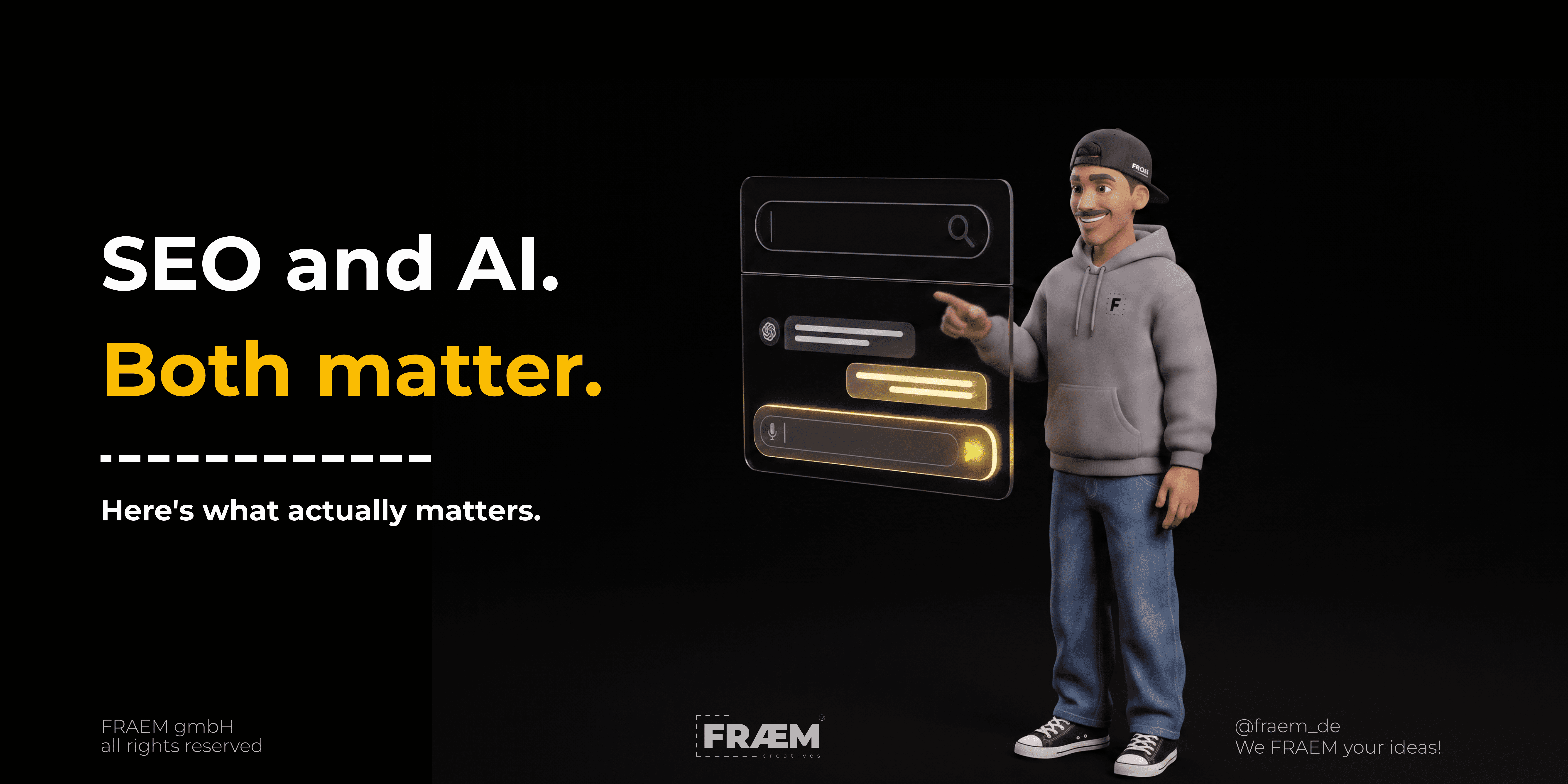
AI Search Is Here. SEO Isn't Dead. Here's What Matters.
43% of Germans use ChatGPT. Search is quietly changing under everyone's feet. Here's what's real, what's hype, and what your business should actually do about it.

Sales vs. Marketing: Who's Actually Right?
The classic sales vs. marketing argument is rarely about who's right. It's usually about a disconnect nobody wants to name. Here's how to spot it, and how to fix it.

Marketing in Trades and Construction, Done Right
Trades, construction and industry don't work like other sectors. Here's what we've learned from years of doing marketing in this space, with examples from the work.
How Handwerk Businesses Actually Find Azubis: 5 Steps
Finding Azubis and skilled workers in Handwerk: why job ads alone don't work and which five steps actually bring applications.
AI Search Is Here. SEO Isn't Dead. Here's What Matters.
43% of Germans use ChatGPT. Search is quietly changing under everyone's feet. Here's what's real, what's hype, and what your business should actually do about it.
Sales vs. Marketing: Who's Actually Right?
The classic sales vs. marketing argument is rarely about who's right. It's usually about a disconnect nobody wants to name. Here's how to spot it, and how to fix it.
How Handwerk Businesses Actually Find Azubis: 5 Steps
Finding Azubis and skilled workers in Handwerk: why job ads alone don't work and which five steps actually bring applications.
AI Search Is Here. SEO Isn't Dead. Here's What Matters.
43% of Germans use ChatGPT. Search is quietly changing under everyone's feet. Here's what's real, what's hype, and what your business should actually do about it.

Why Your Handwerk Website Isn't Doing Its Job
94% of German Handwerk businesses have a website. Only 3 of 500 audited sites came close to actually doing their job. Here's what "it works for us" is really costing you.

Framer vs. WordPress vs. TYPO3
Framer or WordPress for your Handwerk business? An honest comparison on cost, maintenance, and SEO. Plus when Webflow or TYPO3 actually makes sense.
Content that converts
(and doesn’t suck).
Let’s talk.
Content that converts
(and doesn’t suck).
Let’s talk.
Content that converts
(and doesn’t suck).
Let’s talk.


Nikkan & Soli Managing Directors
Nikkan & Soli Managing Directors
Nikkan & Soli Managing Directors